Reactivity was not one of the topics of the seminar. There was no power-point presentation, nor was there an official outline on the matter. Despite that, I'm still going to write about Jane's comments on reactivity. The reader should understand that this is not a comprehensive training plan. Although I have some ideas of how Jane approaches reactive dogs based on what she said, this cannot be taken as her entire method. This post is being put together based on off-hand comments and responses to audience questions, so please, take it as such.
With all that said, my impression was that Jane does not alter her approach to reactive dogs that much. It appeared that her work with all dogs- reactive or not- is based on getting the dog operant, teaching stellar attention skills, and then expanding the dog's “envelope.” Again, maybe this was because of the constraints of the seminar, but I was disappointed and uncomfortable with her approach. Let me explain why:
Get the Dog Operant
According to Jane, reactive dogs (and their aggressive counterparts) need to be operant, maybe even more so than “normal” dogs. She said this is true because reactivity and aggression come from the same area of the brain as frustration, and frustration results from not knowing how to solve problems. By creating an operant dog, you get a dog who understands how to solve problems, which will reduce his frustration levels. In turn, Jane told us, you will reduce reactivity. At the same time, getting an operant dog is vital because it helps the dog and human learn how to communicate with one another. Of course, you'll still need to work on what, exactly, you communicate, but having an operant dog who understands how to communicate with you will go a long way towards reducing reactivity.
I can certainly see the value in this. Having a dog who understands he can control his environment with his behavior is a beautiful thing, and is at the heart of many of the training protocols available- like CAT, BAT, Control Unleashed, etc. Of course, the great challenge is harnessing that ability in a way you like. Early on in my work with Maisy, I inadvertently taught her that she could offer the behavior of barking and lunging at other dogs. This was the exact opposite of what I wanted her to learn, and indeed, was the fault of my own poor training. Getting an operant dog will not solve a behavior problem; it only gives you a chance to solve it.
But this emphasis on operancy also overlooks a huge area of training: classical counter-conditioning. I firmly believe that counter-conditioning is very important when working with reactive or aggressive dogs because it gives us a solid foundation upon which to build. Classical conditioning cannot be the sole answer- there will come a point where it's impossible to maintain, requiring you to switch to an operant technique- but I think it is often overlooked all the same. Now, Jane did recognize that “Pavlov is always on your shoulder” (that is, that classical conditioning always takes place alongside operant conditioning), but I felt she gave short shrift to the power in classical conditioning. Again, this was probably because it was outside the scope of the seminar, but if she uses it in her work with reactive dogs, I wish she would have at least mentioned it.
Teach Stellar Attention Skills
I've already alluded to the fact that Jane believes strong attention skills are vital for dogs. She stated that pretty much every problem you have with your dog is because he doesn't understand the concept of attention, and what's more, that reactive/aggressive dogs “need to have unbroken attention on me.”
To this end, she showed us a video of her then-18-week-old cattle dog, who was very sensitive to the environment. In the case of this video, the environment in question was a dog show; Jane was there to film a specialty, and during one of the down-times, she let her puppy come out to explore. The video showed the dog entering an area, straining at the end of the leash and scanning. The dog's tail was straight, vertical, and stiff as it stared. At one point, the dog erupted into barking. Throughout this, Jane's only response was to capture and click/treat eye contact. In the next segment, taken after some time had elapsed (but no further training had occurred), Jane and the dog entered the area. The dog immediately reoriented to her, and gave her some excellent eye contact, virtually ignoring what was going on around them.
The video was impressive. The change in the dog was dramatic. And yet... I didn't buy it. Not that I don't believe the events occurred as she said they did- I'm sure they did- but I don't believe this would work with every reactive dog. At any rate, I know this would not have worked for Maisy, because I have tried similar things. I figured this must be because Jane's dog was simply environmentally sensitive, while Maisy has a diagnosed anxiety disorder that required medication to resolve. Convinced this was the case, I approached her after the seminar to inquire if she would do things differently with a dog like mine. No. She would not. The technique probably didn't work for me because my skills are not as good as hers.
Expand the Dog's Envelope
Environmentally sensitive dogs, Jane told us, must be trained to work despite the spider (or whatever) in the room. They need to learn to ignore those distractions. Basically, reactivity is one big “proofing” exercise (except Jane doesn't call it that because she thinks proofing implies correction). As a result, she works with a reactive dog the same way she works with any other dog in this regard: she finds the envelope and gradually increases it.
The only difference is that she said with a reactive dog, you much work much slower, and push on the envelope much more gently. If you allow your dog to go over threshold (a word she does not use, because she said everyone understands it differently), you have made a mechanical error. Dogs who go “outside the envelope” end up with a cascade of chemicals releasing in the brain, which sidelines your training as the dog recovers from the stress.
I agree that you should not let a dog go over threshold; the resultant cortisol release means that you're stuck with an edgier dog for the next 72 hours (or longer- pre-medication, Maisy often needed up to a week to recover). But I am confused by Jane's idea of what going over threshold looks like; in the video of her cattle dog, the tight, tense body language and eruption of barking seemed like a reactive response to me. When I asked her about it, though, she said the barking was an alert barking, not reactive barking. Certainly, she knows her dog better than I, but I was uncomfortable with this response.
What about Stress?
Many seminar participants noted that some of the dogs looked stressed while working. Jane's response to this was that you don't know what your dog is thinking or feeling, so it doesn't really matter. She encouraged people to let dogs think through their stress (probably okay with a “normal” dog, but a bit worrisome for me with a reactive dog). For the more stressed dogs, she encouraged the handlers to select and reinforce relaxed body language (looking at ears, mouths, etc.).
Again, I was uncomfortable with this. Although she did adjust criteria/the environment for some of the dogs, for the most part, she pushed them far beyond their comfort zone- as demonstrated by body language- than I would do with my own dog. She believes this is where learning occurs. I agree that stress is inevitable in life, and that we need to help our dogs learn how to think through stress. At the same time, if a dog is too stressed, he cannot learn. Jane did emphasize that you need to skim the edges of stress for reactive dogs, but it seemed we had different ideas of where that edge is.
So is Jane wrong? No. Her techniques are clearly successful; she has a dog-aggressive dog of her own, and that dog was nationally ranked in APDT rally. But I don't think that means I am wrong, either. I, too, have a dog who was nationally ranked in APDT rally. And while my skills aren't even close to Jane's, I am proud of my accomplishments with Maisy, and I believe that in time, I will develop better training abilities.
In the end, I think there is enough room in the world for people to train in different ways, and to have different beliefs about how to approach the same problem. Jane has chosen a strict behavioral view. She trains the dog and the behavior she sees in front of her. I have chosen to follow a more emotional, relationship-focused method. Neither of us are wrong, even if we are uncomfortable with the other's views. Indeed, it is in these areas of discomfort that the most learning takes place.
Jane's seminar forced me to confront my own views and to examine them. Although this post concludes the official seminar recap, you can be assured that there will be many posts to come exploring my own thoughts and ideas on reactivity, training, and dogs in general. And perhaps that is the most important thing I took away from this seminar. Even if I didn't agree with everything I saw, I sure did learn a lot.

Showing posts with label jane killion. Show all posts
Showing posts with label jane killion. Show all posts
Sunday, March 11, 2012

Thursday, March 8, 2012
Jane Killion Seminar: Overcoming Training Challenges

Everyone who trains dogs has training challenges. Whether it is something as minor as a puppy who doesn't want to lie down when asked or something as serious as aggression, we all face difficulty with our dogs. Jane has created a four-step protocol for overcoming these challenges. Today, I'm going to share it with you.
Step 1: Define the Behavior You Want
This might seem easy, but it's actually the hardest part. When faced with a challenge, we humans tend to describe it in negative terms. We talk about the horrible thing our dog is doing, about what we wish he would stop doing. But what we really need to do is start thinking about what we want to see instead.
Not only do we need to shift our thinking, but we also need to be specific. What exactly would that behavior look like? How would it play out? Jane cautioned us not to fool ourselves by simply following the rules; we need to branch out and figure out what the spirit of the rule is.
So let's say you're having trouble training your dog to stay. Maybe it's in competition obedience, maybe it's at the agility start line, maybe it's in your kitchen. What does it mean to stay? Well, it's when the dog sits and doesn't get up until you tell him, right? Oops- that was describing it as a negative.
Okay, how about this: a stay is where the dog sits and holds that position. Well, that's not bad, but Jane challenged to think more deeply about the behavior. How should he be sitting- straight and square, or kind of flopped over on one hip? Does it matter where he's looking? Should his head be held level or is it okay if he tries to sniff the floor while sitting there? Think about the purpose behind the behavior. If you just want him to stay put, these variables probably don't matter as much. However, if you want him to go from sitting to full speed and over a jump or through a tunnel when told, they matter a great deal. Decide what you need the behavior to accomplish.
Step 2: Train the Behavior You Want
This is actually the easiest part; the average seminar attendee (and I'd guess the vast majority of my readers) can figure out how to teach her dog to perform any given behavior. If you're not sure how to get the behavior you want, consult with a professional trainer.
Step 3: Find the Envelope
If you've ever been to a dog training class, you've probably heard someone lament, “But he can do it perfectly at home!” It's true, too; we all know that her dog can do it at home because of the lack of distractions. Once other dogs or tennis balls or interesting scents are added into the picture, the dog's behavior breaks down. “The envelope” is the specific context in which your dog can perceive, understand, and respond to the cue.
When you first teach a behavior, the behavior envelope is quite small. The dog can only respond when everything is just perfect. In this step, you only need to figure out where that envelope is. What needs to happen for the dog to be successful? What causes the dog to “forget” the behavior? Find out where your dog's training is.
Step 4: Work the Envelope
Now that you've found the envelope, it's time to start making it bigger. Doing this creates more contexts in which the dog can perform, and helps him understand that the cue word means the same thing, no matter where he is or what's going on.
You need to work right at the edges. If you push gently, the envelope will expand. If you start pushing and shoving, though, it's likely that you'll tear the envelope. You might be able to tape it shut and repair the behavior, but you might also need to start all over again with a new envelope.
When Jane was working with dogs in the seminar, she would work at those edges a lot. Her goal was to be at a level of distraction where she was on the verge of losing the dog to the more interesting thing, but where she was also reasonably confident she'd get him back. Because she doesn't like to nag or beg a dog to work, sometimes the dog did leave. Although her goal was to set up the situation so this didn't happen, sometimes she misjudged how much distraction the dog could endure and the dog (and let's face it- a seminar setting is a difficult place to work with a dog). This was okay; she'd simply wait the dog out and let him make the choice to come back to work because she believes that's where real learning occurs.
By following these four steps, the dogs all made a lot of progress. Most of the working dogs did agility, so the demonstrations were largely focused on solving challenges specific to the sport. While much of it went beyond my understanding, even I could see that the dogs improved a great deal. It was very fun to watch.
What do you think? Would following this protocol help you solve the challenges you're currently facing? Why or why not?
Sunday, March 4, 2012
Jane Killion Seminar: Attention is a Behavior, and You Can Teach It!
Does your dog blow you off, ignore you, or run away? Do you feel frustrated by his lack of focus? Do you want him to pay more attention to you? Well, you’re in luck, because Jane told us at the seminar that attention is a behavior, and you can teach it. Today I’m going to share Jane’s two-step method for creating an attentive dog.
Step 1: Teach the Concept
You might think you’ve done this. After all, you’re a caring dog owner interested in training, so you’ve probably taught your dog to make eye contact when cued. But this, Jane argued, is missing the point. As she put it, attention is like respect. If you have to ask for it, you’ll never get it. If you’re calling your dog, nagging him, or begging for attention, then he’s learned nothing… except maybe that he can disengage from you to do whatever he’d like because you’ll let him know when it’s time to pay attention.
What Jane wants is a dog who chooses to be attentive. To that end, the concept Jane encouraged us to teach is not cued eye contact, nor is it for the dog to ignore distractions when told. Instead, she said that true attention is achieved when the dog learns that distractions themselves are cues to focus on the handler. In other words, when the dog realizes there is something interesting out there, he should not only ignore it, but also make eye contact with his handler without being told to do so.
Jane starts teaching this by letting the dog know that eye contact is a behavior he can offer in order to receive a click and treat. She showed us how to do that by putting a dog on leash and simply waiting. When the dog would make eye contact, no matter how briefly, she would click and treat. She had each dog/handler team repeat this until it was clear the dog understood that he can make the click happen by offering eye contact.
With this foundation in place, Jane began to raise the criteria using the classic technique of introducing distractions. Jane had the handlers hold a fistful of treats out to the side. Most dogs will stare at the food when this happens, and our working dogs were no exception. Again, Jane just had the handlers wait. She cautioned that they should not call the dogs, make noises, or otherwise prompt them to make eye contact. Simply wait. When the dog looked, he would get a click and treat. Again, she had the teams repeat the exercise until it was clear the dog was offering attention as a behavior to earn the treats.
But remember, the concept is not simple eye contact; Jane’s goal was for the dogs to learn that those distractions are a cue for the dog to pay attention to the handler. Because of this, Jane does not want a dog to look away from the handler, check out the distraction, and then look back. Instead, she wants the dog to understand that as soon as he’s aware of the distraction, he should put his complete focus on his handler. So instead of making the distraction bigger or harder, Jane actually had the working teams raise the criteria by only clicking when the dog refused to look at the distraction.
Here’s how the exercise was set up: the handler would present a distraction (usually by holding a handful of treats out to the side), and the dog would be allowed to look at it, then look at his handler and earn a click/treat. The handler would then remove the distraction (by putting her behind her back, for example), and then present it again, which started the exercise over. After a few reps, the criteria would be raised. Now the dog would only get clicked if he maintained eye contact and ignored the distraction. The first few times, the dog would look at the distraction before looking back at his handler. However, now that the criteria had been raised, he would not get clicked for this. Every single dog soon realized that he shouldn’t look at the distraction at all, and thus would choose to keep looking at his handler, which earned him a click and treat. It was pretty awesome to watch.
Step Two: Work the Envelope
Once the dog learned the concept, Jane began to do what she calls “working the envelope.” This is the phrase Jane uses to describe the process of gradually making the training task more difficult. She would change one thing at a time, with the goal being that the change was large enough that the dog would notice, but not so large that he couldn’t quickly return his attention to his handler.

Again, she would allow a few reps of look-at-the-distraction-then-back-at-the-handler before requiring the dog to ignore the distraction entirely in order to get clicked. Each team worked with different levels of distraction. For more novice dogs, the handful of treats might simply be moved closer to his face, while more advanced dogs were required to ignore Jane while she stepped towards them or crinkled a treat bag.
Although she couldn’t demonstrate the entire evolution of the process due to time constraints, Jane did share that pretty much all training is just an expansion of the attention concept. What’s more, she stated that pretty much every problem you have with your dog’s performance is because he doesn’t understand the concept of attention. She even argued that teaching solid attention skills is at the core of working with reactivity or aggression. While I think attention skills are helpful, I know from my own experiences with Maisy that it's not a one-size-fits-all solution, and I have my doubts that what I saw would have worked.
But that is for another post. In the meantime, I'd love to hear from others. How have you taught attention skills? What do you think of Jane's method? Do you cue attention, or have you taught your dog to view the distraction itself as the cue?
Step 1: Teach the Concept
You might think you’ve done this. After all, you’re a caring dog owner interested in training, so you’ve probably taught your dog to make eye contact when cued. But this, Jane argued, is missing the point. As she put it, attention is like respect. If you have to ask for it, you’ll never get it. If you’re calling your dog, nagging him, or begging for attention, then he’s learned nothing… except maybe that he can disengage from you to do whatever he’d like because you’ll let him know when it’s time to pay attention.
What Jane wants is a dog who chooses to be attentive. To that end, the concept Jane encouraged us to teach is not cued eye contact, nor is it for the dog to ignore distractions when told. Instead, she said that true attention is achieved when the dog learns that distractions themselves are cues to focus on the handler. In other words, when the dog realizes there is something interesting out there, he should not only ignore it, but also make eye contact with his handler without being told to do so.
Jane starts teaching this by letting the dog know that eye contact is a behavior he can offer in order to receive a click and treat. She showed us how to do that by putting a dog on leash and simply waiting. When the dog would make eye contact, no matter how briefly, she would click and treat. She had each dog/handler team repeat this until it was clear the dog understood that he can make the click happen by offering eye contact.
With this foundation in place, Jane began to raise the criteria using the classic technique of introducing distractions. Jane had the handlers hold a fistful of treats out to the side. Most dogs will stare at the food when this happens, and our working dogs were no exception. Again, Jane just had the handlers wait. She cautioned that they should not call the dogs, make noises, or otherwise prompt them to make eye contact. Simply wait. When the dog looked, he would get a click and treat. Again, she had the teams repeat the exercise until it was clear the dog was offering attention as a behavior to earn the treats.
But remember, the concept is not simple eye contact; Jane’s goal was for the dogs to learn that those distractions are a cue for the dog to pay attention to the handler. Because of this, Jane does not want a dog to look away from the handler, check out the distraction, and then look back. Instead, she wants the dog to understand that as soon as he’s aware of the distraction, he should put his complete focus on his handler. So instead of making the distraction bigger or harder, Jane actually had the working teams raise the criteria by only clicking when the dog refused to look at the distraction.
Here’s how the exercise was set up: the handler would present a distraction (usually by holding a handful of treats out to the side), and the dog would be allowed to look at it, then look at his handler and earn a click/treat. The handler would then remove the distraction (by putting her behind her back, for example), and then present it again, which started the exercise over. After a few reps, the criteria would be raised. Now the dog would only get clicked if he maintained eye contact and ignored the distraction. The first few times, the dog would look at the distraction before looking back at his handler. However, now that the criteria had been raised, he would not get clicked for this. Every single dog soon realized that he shouldn’t look at the distraction at all, and thus would choose to keep looking at his handler, which earned him a click and treat. It was pretty awesome to watch.
Step Two: Work the Envelope
Once the dog learned the concept, Jane began to do what she calls “working the envelope.” This is the phrase Jane uses to describe the process of gradually making the training task more difficult. She would change one thing at a time, with the goal being that the change was large enough that the dog would notice, but not so large that he couldn’t quickly return his attention to his handler.

Tibby has figured out that when Jane moves towards her, she should look at her mom.
Again, she would allow a few reps of look-at-the-distraction-then-back-at-the-handler before requiring the dog to ignore the distraction entirely in order to get clicked. Each team worked with different levels of distraction. For more novice dogs, the handful of treats might simply be moved closer to his face, while more advanced dogs were required to ignore Jane while she stepped towards them or crinkled a treat bag.
Although she couldn’t demonstrate the entire evolution of the process due to time constraints, Jane did share that pretty much all training is just an expansion of the attention concept. What’s more, she stated that pretty much every problem you have with your dog’s performance is because he doesn’t understand the concept of attention. She even argued that teaching solid attention skills is at the core of working with reactivity or aggression. While I think attention skills are helpful, I know from my own experiences with Maisy that it's not a one-size-fits-all solution, and I have my doubts that what I saw would have worked.
But that is for another post. In the meantime, I'd love to hear from others. How have you taught attention skills? What do you think of Jane's method? Do you cue attention, or have you taught your dog to view the distraction itself as the cue?
Thursday, March 1, 2012
Jane Killion Seminar: Shaping
I don’t think I have ever met a trainer with better shaping skills than Jane Killion. At times, it seemed like it’s the only tool she uses (and I’ll talk more about that in my posts on her approach to reactivity, aggression, and attention), but I’ve got to admit that if I was even half as good at shaping as she is, I might not feel the need to use other approaches. Honestly, her skills are just phenomenal.
So, what is shaping? Shaping is the process of teaching a dog a new behavior in small, incremental steps. Instead of trying to teach the entire behavior all at once, shaping builds it up, one piece at a time. Jane used the analogy of a movie: if the behavior is what you would see in the final video clip, then shaping is the process of teaching that behavior one frame at a time.
More specifically, Jane does something called free shaping, which is where the dog offers each successive behavior as opposed to the trainer prompting, luring, compelling, or showing the dog what to do. Jane makes this distinction because she wants the dog to be the active participant. Since a “Pigs Fly” dog tends to be an independent thinker, free shaping harnesses the dog’s natural ability.
It also creates a dog who is “obsessed” with solving problems. Jane believes that free shaping taps into the SEEKING circuit in the brain, and since we know that anticipation is reinforcing, this means that the dog who has learned via shaping will find solving training challenges to be inherently reinforcing. This makes shaping a valuable tool for the “Pigs Fly” dog who isn’t all that interested in pleasing his person.
If this sounds wonderful, it’s because it is. But there is a catch! For free shaping to work, the dog has to be operant. This means that the dog understands that his behavior will earn a click and treat, and even more importantly, that he actively offers behaviors in order to earn the reward.
 Jane teaches a dog how to be operant by playing The Box Game. To play, set a box on the floor and click/treat any interaction with the box that your dog offers. Any interaction. You aren’t teaching a behavior, so you should click anything and everything your dog does with, near, or to the box. Dog looks at the box? Click Dog sniffs at it? Click. Dog paws it? Click. Dog steps in it? Click. Dog jumps over it? Click. And if your dog will have nothing to do with the box? Click him for looking away from it, or even for getting up and walking away. That may sound weird, but remember, the goal is not teaching a behavior, it’s to teach the dog the concept of offering behaviors.
Once your dog is eagerly offering behaviors, it’s time to start shaping a behavior. Jane had working participants shape a behavior related to the box. This allowed the handlers (and the dogs!) to practice their new-found skills with something that doesn’t really matter. Choosing a "silly" behavior is important, because when people start with behaviors they care about, they tend to get tense and worried, which interferes with their ability to train.
To shape a behavior, start by thinking about what you want to teach. Jane said that the key to training lies in setting up your sessions well. You should spend more time planning than training. Have a very clear picture of what you want, and be sure to state it in terms of what the dog will do, not what he won’t do. For example, a sit-stay is defined as “sitting and holding that position” as opposed to “sitting and not changing position.”
Next, figure out what each step will be. Again, think of the final behavior as a movie, and visualize each frame. The change between each step should be very small. For example, if the behavior is teaching your dog to go lie on his bed, you might say that the first step is for the dog to turn his head towards the bed. Jane, however, would say the first step is for the neck muscles to move, or for the dog's eyes to flick in the direction of the bed. Like I said: tiny steps.
Click/treat that first step repeatedly until it is clear that the dog is deliberately offering the behavior. The amount of time you spend on this step will depend on the dog; if he’s done a lot of shaping, you might only need to click each step two or three times, but if this is his first time out, you might need to click it a hundred times.
Now, stop clicking. If your dog understood that his behavior was resulting in reinforcement, he will probably be a little confused. He will likely try the behavior again a few times. When that doesn't produce a click, he will start to offer variations on the behavior, trying to figure out what it is you want. Pick one that takes you closer to your end goal and click/treat that. Technically, your dog is going through an extinction burst, so be quick, before the dog gives up entirely. While much of training is a science, there is definitely an art to determining when to stop clicking, and what to click after that.
A lot of the working dogs were already operant, having had experience with shaping. In fact, some of them were almost frantic in their efforts to offer clickable behaviors. Jane acknowledged that shaping can be messy and chaotic at times. This is often hard for people to accept, especially if they are used to dogs who wait to be told what to do, or who really want to control their dogs.
That said, there are problems unique to shaping, although they are almost always due to timing. (Of course, poor timing is a problem no matter how you train, it’s just that poor clicker timing results in a different set of problems than in a poorly timed collar correction.) Almost every clicker problem can be solved simply by clicking earlier. Barking out of frustration during training is usually a very smart, fast dog saying “I did it! Click me already!” Dogs who throw lots of behaviors usually are not sure what the trainer wants because of her poor timing. And superstitious behaviors- those things that the dog thinks is part of the behavior but really isn’t- usually creep in due to late timing.
Timing and splitting behaviors down into tiny pieces seem to go hand in hand. For example, when Jane was working on teaching a dog to jump, she started with clicking the dog for seeing/committing to the jump versus going over it. Not only does slicing the criteria like this make it easier to shape the dog, but it also means that if your click is even a half-second late, you’re probably still clicking the goal behavior- in this case, jumping- instead of the behavior after it, like landing.
It was pretty amazing to watch Jane work with the dogs because her timing was just so good, and the lesson of clicking early was definitely something I needed. My timing is pretty good, but it is nowhere near Jane’s level of pure awesomeness. I am going to work hard to click sooner and to break down behaviors into smaller pieces. I think both things will really benefit my ability to teach the behaviors I want.
Coming up soon: using shaping to create an attentive dog and solve behavior challenges.
So, what is shaping? Shaping is the process of teaching a dog a new behavior in small, incremental steps. Instead of trying to teach the entire behavior all at once, shaping builds it up, one piece at a time. Jane used the analogy of a movie: if the behavior is what you would see in the final video clip, then shaping is the process of teaching that behavior one frame at a time.
More specifically, Jane does something called free shaping, which is where the dog offers each successive behavior as opposed to the trainer prompting, luring, compelling, or showing the dog what to do. Jane makes this distinction because she wants the dog to be the active participant. Since a “Pigs Fly” dog tends to be an independent thinker, free shaping harnesses the dog’s natural ability.
It also creates a dog who is “obsessed” with solving problems. Jane believes that free shaping taps into the SEEKING circuit in the brain, and since we know that anticipation is reinforcing, this means that the dog who has learned via shaping will find solving training challenges to be inherently reinforcing. This makes shaping a valuable tool for the “Pigs Fly” dog who isn’t all that interested in pleasing his person.
If this sounds wonderful, it’s because it is. But there is a catch! For free shaping to work, the dog has to be operant. This means that the dog understands that his behavior will earn a click and treat, and even more importantly, that he actively offers behaviors in order to earn the reward.
 Jane teaches a dog how to be operant by playing The Box Game. To play, set a box on the floor and click/treat any interaction with the box that your dog offers. Any interaction. You aren’t teaching a behavior, so you should click anything and everything your dog does with, near, or to the box. Dog looks at the box? Click Dog sniffs at it? Click. Dog paws it? Click. Dog steps in it? Click. Dog jumps over it? Click. And if your dog will have nothing to do with the box? Click him for looking away from it, or even for getting up and walking away. That may sound weird, but remember, the goal is not teaching a behavior, it’s to teach the dog the concept of offering behaviors.
 Once your dog is eagerly offering behaviors, it’s time to start shaping a behavior. Jane had working participants shape a behavior related to the box. This allowed the handlers (and the dogs!) to practice their new-found skills with something that doesn’t really matter. Choosing a "silly" behavior is important, because when people start with behaviors they care about, they tend to get tense and worried, which interferes with their ability to train.
To shape a behavior, start by thinking about what you want to teach. Jane said that the key to training lies in setting up your sessions well. You should spend more time planning than training. Have a very clear picture of what you want, and be sure to state it in terms of what the dog will do, not what he won’t do. For example, a sit-stay is defined as “sitting and holding that position” as opposed to “sitting and not changing position.”
Next, figure out what each step will be. Again, think of the final behavior as a movie, and visualize each frame. The change between each step should be very small. For example, if the behavior is teaching your dog to go lie on his bed, you might say that the first step is for the dog to turn his head towards the bed. Jane, however, would say the first step is for the neck muscles to move, or for the dog's eyes to flick in the direction of the bed. Like I said: tiny steps.
Click/treat that first step repeatedly until it is clear that the dog is deliberately offering the behavior. The amount of time you spend on this step will depend on the dog; if he’s done a lot of shaping, you might only need to click each step two or three times, but if this is his first time out, you might need to click it a hundred times.
Now, stop clicking. If your dog understood that his behavior was resulting in reinforcement, he will probably be a little confused. He will likely try the behavior again a few times. When that doesn't produce a click, he will start to offer variations on the behavior, trying to figure out what it is you want. Pick one that takes you closer to your end goal and click/treat that. Technically, your dog is going through an extinction burst, so be quick, before the dog gives up entirely. While much of training is a science, there is definitely an art to determining when to stop clicking, and what to click after that.
A lot of the working dogs were already operant, having had experience with shaping. In fact, some of them were almost frantic in their efforts to offer clickable behaviors. Jane acknowledged that shaping can be messy and chaotic at times. This is often hard for people to accept, especially if they are used to dogs who wait to be told what to do, or who really want to control their dogs.
That said, there are problems unique to shaping, although they are almost always due to timing. (Of course, poor timing is a problem no matter how you train, it’s just that poor clicker timing results in a different set of problems than in a poorly timed collar correction.) Almost every clicker problem can be solved simply by clicking earlier. Barking out of frustration during training is usually a very smart, fast dog saying “I did it! Click me already!” Dogs who throw lots of behaviors usually are not sure what the trainer wants because of her poor timing. And superstitious behaviors- those things that the dog thinks is part of the behavior but really isn’t- usually creep in due to late timing.
Timing and splitting behaviors down into tiny pieces seem to go hand in hand. For example, when Jane was working on teaching a dog to jump, she started with clicking the dog for seeing/committing to the jump versus going over it. Not only does slicing the criteria like this make it easier to shape the dog, but it also means that if your click is even a half-second late, you’re probably still clicking the goal behavior- in this case, jumping- instead of the behavior after it, like landing.
It was pretty amazing to watch Jane work with the dogs because her timing was just so good, and the lesson of clicking early was definitely something I needed. My timing is pretty good, but it is nowhere near Jane’s level of pure awesomeness. I am going to work hard to click sooner and to break down behaviors into smaller pieces. I think both things will really benefit my ability to teach the behaviors I want.
Coming up soon: using shaping to create an attentive dog and solve behavior challenges.
Tuesday, February 28, 2012
Jane Killion Seminar: Reinforcement Training
Jane Killion is a reinforcement trainer.
Notice the words I chose there, because she doesn't call herself a positive trainer. Why? Well, in behavior science, all “positive” means is “add.” You add something in order to manipulate future behavior. Sometimes you add something in order to increase a behavior, and sometimes you add something in order to decrease a behavior. Technically speaking, this label can easily refer to some wildly divergent training methods. But Jane also feels the term “positive” can be divisive. Since so many people misunderstand it to mean upbeat, kind, or virtuous, it implies that people use use other methods aren't. What's more, it also implies that anyone who is nice must automatically be positive, which is misleading.
As a result, Jane favors the term “reinforcement training.” Her methods are based on providing reinforcement to the dog, whether that's by adding something desirable to increase a behavior (positive reinforcement), or by removing something unpleasant in order to increase a behavior (negative reinforcement). What she avoids whenever possible is the use of punishment, as all that does is suppress behavior, not teach the dog what you want him to do.
Training under the umbrella of reinforcement gives a trainer a variety of things to use to create behavior. Without a doubt, the most popular- and Jane's favorite- is to use food. Not only is it a primary reinforcer, but it's also easy to dispense, easy to control, and it tends to tap into the “thinking” part of the dog's brain.
 Of course, any one who has worked with dogs knows that sometimes training with treats just doesn't work. Jane identified two main reasons this happens: emotional interference (ie, stress), or competing reinforcers that are more relevant or interesting. After all, when it comes down to a choice between eating a bit of hot dog and chasing a squirrel, most dogs will choose the squirrel. And if you're working with a “Pigs Fly” dog, the chances that he will choose the environment over you is large.
That doesn't mean that you can't use positive reinforcement with a dog who isn't interested in food. You can, it just takes a bit of creativity. Enter Premack, a principle which states that a high probability behavior can be used to reinforce a low probability behavior. If your eyes just glazed over, don't worry; Jane has come up with a very clever way of describing the Premack principle. She calls it ICE: Identify “hot” reinforcers (anything your dog wants, which might include sniffing the ground, rolling in something stinky, or peeing on a bush), Control them, and then Exchange a behavior for the hot reinforcer.
Jane showed us an excellent video of her working with a very distracted young dog that really wanted to do was explore and sniff, which was incompatible with his owner's desire that he walk nicely on the leash. In the video, Jane identified the hot reinforcer (sniffing), controlled that reinforcer by shortening the leash so he couldn't sniff, and then waited for an opportunity to exchange a behavior for sniffing. As soon as the dog looked at her, she let out the slack in the leash and told him to go sniff. After a few moments, she shortened the leash again, and the process repeated. Soon, he was willingly paying attention to her while they walked through the field together. Pretty cool.
As the video demonstrated, Premack is a powerful thing, and I wish she would have demonstrated it live during the seminar. I can understand why she didn't- we had limited time, and Premack takes longer than handing out a cookie- but I was still a bit disappointed. There was even a great opportunity to demonstrate Premack/her ICE system since one of the working dogs had a medical problem that made it difficult to use food for training, but instead Jane had that handler switch out for a different dog.
Another way to train with reinforcement is through negative reinforcement. This often ignored method has us remove something aversive in order to provide relief to the dog. This is a powerful thing, and dogs and people alike will perform behaviors that bring them relief. Jane was clear that she will not add the aversive herself, but that she will use unpleasant things that are already present; a shiny floor, perhaps, or the presence of the judge leaning over the dog to do the stand for the exam. And, Jane said, often the equipment in agility is a stressful thing for dogs.
To that end, she showed us another excellent video demonstrating how reward placement can provide negative reinforcement. On screen, we saw a dog who was hesitant to jump on the table, an agility obstacle that requires the dog to stay on a platform for several seconds before moving on to the next obstacle. The dog in question was slow and reluctant to get on it and lie down. Jane shaped the dog in several steps to move towards, get on, and then lie down on the table, each time throwing the treat away from the table, which allowed the dog relief from the piece of equipment he found unpleasant. Soon, she had a dog eagerly offering the desired behavior.
Again, I was disappointed that she didn't demonstrate the use of negative reinforcement during the seminar, even though there was actually a training problem that could have been set up to take advantage of it. One of the working dogs was having trouble performing recalls in the presence of other people. Jane chose to have people stand in two rows, then instructed the handler to call the dog to run between them. I would have loved to see Jane use some negative reinforcement in this situation through the relief of social pressure by having the people move back when the dog responded. This could have been a powerful reward for this dog, but instead, the dog got a treat when she came.
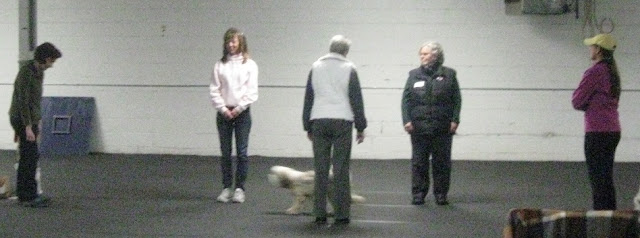
Now, there's nothing wrong with this. The approach worked; the dog was able to improve her ability to come despite the presence of people, but it was stressful for the dog. Jane was okay with this; learning is stressful, she said. She's right, of course, but after my experiences with Maisy- a dog with clinical anxiety- I have far less tolerance for stress during training. As a result, I just wasn't comfortable watching the amount of stress the working dog endured- especially when Jane could have used negative reinforcement to relieve the dog's stress while still accomplishing her goal.
As these two examples demonstrate, most of what Jane showed us over the course of the weekend was straight positive-reinforcement-with-food. More to the point, Jane has a tendency to shape everything. At times, it felt like this the only tool she has, but then, she's so good at it, she doesn't really need anything else.
I doubt that I will ever attain her level of skill in observation, setting criteria, and timing, but I am hopeful that having the chance to watch her will improve my own abilities. I look forward to telling you about some of what I learned... But it will have to be in the next post, as this one has gotten far too long already.
Notice the words I chose there, because she doesn't call herself a positive trainer. Why? Well, in behavior science, all “positive” means is “add.” You add something in order to manipulate future behavior. Sometimes you add something in order to increase a behavior, and sometimes you add something in order to decrease a behavior. Technically speaking, this label can easily refer to some wildly divergent training methods. But Jane also feels the term “positive” can be divisive. Since so many people misunderstand it to mean upbeat, kind, or virtuous, it implies that people use use other methods aren't. What's more, it also implies that anyone who is nice must automatically be positive, which is misleading.
As a result, Jane favors the term “reinforcement training.” Her methods are based on providing reinforcement to the dog, whether that's by adding something desirable to increase a behavior (positive reinforcement), or by removing something unpleasant in order to increase a behavior (negative reinforcement). What she avoids whenever possible is the use of punishment, as all that does is suppress behavior, not teach the dog what you want him to do.
Training under the umbrella of reinforcement gives a trainer a variety of things to use to create behavior. Without a doubt, the most popular- and Jane's favorite- is to use food. Not only is it a primary reinforcer, but it's also easy to dispense, easy to control, and it tends to tap into the “thinking” part of the dog's brain.

That doesn't mean that you can't use positive reinforcement with a dog who isn't interested in food. You can, it just takes a bit of creativity. Enter Premack, a principle which states that a high probability behavior can be used to reinforce a low probability behavior. If your eyes just glazed over, don't worry; Jane has come up with a very clever way of describing the Premack principle. She calls it ICE: Identify “hot” reinforcers (anything your dog wants, which might include sniffing the ground, rolling in something stinky, or peeing on a bush), Control them, and then Exchange a behavior for the hot reinforcer.
Jane showed us an excellent video of her working with a very distracted young dog that really wanted to do was explore and sniff, which was incompatible with his owner's desire that he walk nicely on the leash. In the video, Jane identified the hot reinforcer (sniffing), controlled that reinforcer by shortening the leash so he couldn't sniff, and then waited for an opportunity to exchange a behavior for sniffing. As soon as the dog looked at her, she let out the slack in the leash and told him to go sniff. After a few moments, she shortened the leash again, and the process repeated. Soon, he was willingly paying attention to her while they walked through the field together. Pretty cool.
As the video demonstrated, Premack is a powerful thing, and I wish she would have demonstrated it live during the seminar. I can understand why she didn't- we had limited time, and Premack takes longer than handing out a cookie- but I was still a bit disappointed. There was even a great opportunity to demonstrate Premack/her ICE system since one of the working dogs had a medical problem that made it difficult to use food for training, but instead Jane had that handler switch out for a different dog.
Another way to train with reinforcement is through negative reinforcement. This often ignored method has us remove something aversive in order to provide relief to the dog. This is a powerful thing, and dogs and people alike will perform behaviors that bring them relief. Jane was clear that she will not add the aversive herself, but that she will use unpleasant things that are already present; a shiny floor, perhaps, or the presence of the judge leaning over the dog to do the stand for the exam. And, Jane said, often the equipment in agility is a stressful thing for dogs.
To that end, she showed us another excellent video demonstrating how reward placement can provide negative reinforcement. On screen, we saw a dog who was hesitant to jump on the table, an agility obstacle that requires the dog to stay on a platform for several seconds before moving on to the next obstacle. The dog in question was slow and reluctant to get on it and lie down. Jane shaped the dog in several steps to move towards, get on, and then lie down on the table, each time throwing the treat away from the table, which allowed the dog relief from the piece of equipment he found unpleasant. Soon, she had a dog eagerly offering the desired behavior.
Again, I was disappointed that she didn't demonstrate the use of negative reinforcement during the seminar, even though there was actually a training problem that could have been set up to take advantage of it. One of the working dogs was having trouble performing recalls in the presence of other people. Jane chose to have people stand in two rows, then instructed the handler to call the dog to run between them. I would have loved to see Jane use some negative reinforcement in this situation through the relief of social pressure by having the people move back when the dog responded. This could have been a powerful reward for this dog, but instead, the dog got a treat when she came.

Now, there's nothing wrong with this. The approach worked; the dog was able to improve her ability to come despite the presence of people, but it was stressful for the dog. Jane was okay with this; learning is stressful, she said. She's right, of course, but after my experiences with Maisy- a dog with clinical anxiety- I have far less tolerance for stress during training. As a result, I just wasn't comfortable watching the amount of stress the working dog endured- especially when Jane could have used negative reinforcement to relieve the dog's stress while still accomplishing her goal.
As these two examples demonstrate, most of what Jane showed us over the course of the weekend was straight positive-reinforcement-with-food. More to the point, Jane has a tendency to shape everything. At times, it felt like this the only tool she has, but then, she's so good at it, she doesn't really need anything else.
I doubt that I will ever attain her level of skill in observation, setting criteria, and timing, but I am hopeful that having the chance to watch her will improve my own abilities. I look forward to telling you about some of what I learned... But it will have to be in the next post, as this one has gotten far too long already.
Sunday, February 26, 2012
Jane Killion Seminar: Introduction

Jane calls any dog that is challenging or difficult a “Pigs Fly” dog. Typically, Pigs Fly dogs are terriers or sighthounds- ones who have been selectively bred to work independently of their handler. That said, a Pigs Fly dog is not determined by breed. Any dog can seem impossible to train, and when I talked to Jane about Maisy, she described my seriously biddable dog as a Pigs Fly dog, too. And I suppose it’s true; Maisy may be eager to please, but she hasn’t been easy.
Jane has a training system that she claims will work with any dog, even the ones who aren’t all that interested in pleasing their humans. This system isn’t necessarily new (it’s all based on operant conditioning, and relies heavily on positive reinforcement), but she’s coined some new terminology and phrases that are easier to understand for those who just don’t want to bother with all the scientific terminology (which is probably most people). This makes the Pigs Fly system easily accessible to a wide audience.
 |
| Poor lighting+cheap camera=subpar photos. |
She is also very much a behaviorist. I don’t mean that in the sense that she works with troubled dogs (although she has). No, I mean that she operates from the standpoint that we can’t know what our dogs are thinking or feeling, and that while it’s fun to try and guess, we need to train based on the behavior we see in front of us. She’s not wrong, and while I agree with her to a certain extent, she takes it further than I do. Perhaps I tend to be too anthropomorphic, but I’ll admit that I don’t care for this approach.
In fact, that was very much my feeling on the whole weekend: while she’s not wrong, she also doesn’t resonate with me. The fact of the matter is that she’s a far better mechanical trainer that I will ever be. But her style struck me as cold, sterile, and lacking in heart or soul. And frankly, I was outright uncomfortable with the way this played out at times.
That’s not to say that I didn’t learn anything; on the contrary, I picked up some great tips. Still, the stylistic differences challenged my beliefs and philosophies on training. They forced me to think about who I am as a trainer, as a person, and how my personality influences the way I interact with dogs. In fact, I suspect that I will be reflecting on the weekend for a long time to come, even after I’ve finished blogging about the seminar proper.
But for now, we must focus on the task at hand. Over the next several weeks, I will be bringing you posts covering what I learned. So sit back, relax, and get ready to enjoy Jane Killion in all her brilliance.
Subscribe to:
Posts (Atom)