Initially, I didn't think I'd write about today's topic, not because it isn't interesting, but because I wasn't sure how useful it would be to you, my dear readers. That's because Sunday's topic was about aggression: in puppies, how to assess them, and how to begin working with them. It was also specifically tailored for canine professionals, which I am not. I assume the majority of my readers are not, either. Still, so many people in the blogging world do rescue that I really thought this information should be out there, so today I'm going to write about Sarah's canine risk assessment.
The canine risk assessment is not the same as a temperament test. It comes after the temperament test, after you've already decided that this is a Dog With Issues, and it is meant to be used when you're trying to decide if you can rehabilitate this dog. It is meant to be an objective tool that allows a behavior consultant to make recommendations and gauge the likelihood of success. It does this by giving you a ten-point method of systematically eliciting information that will help you make your decision.
The Canine Risk Assessment
1. What was the age of onset? How long as the behavior gone on?
Generally speaking, an earlier onset and longer duration means a worse prognosis. Sarah said that early onset suggests that the behavior has a genetic component, as opposed to something the dog learned. Learned behaviors are easier to modify than ones that are coming out due to faulty wiring. A longer duration means the dog has had plenty of time to practice the bad behavior, and that those neural pathways become stronger, and the behavior more likely as a result. (See this excellent post for more on this concept.)
2. How specific is the behavior?
Here, we're trying to discover if the behavior happens only in certain settings, or only with certain stimuli, or if it has generalized and happens in respose to very fuzzy triggers. Sarah acknowledged that while it can be harder to work with a very specific behavior (because you have to set up the situation perfectly in order to do behavior modification), it is also lower risk because you can easily predict when it will happen.
3. How predictable is the dog's behavior?
This question is often directly related to the prior one. A dog whose behavior is very specific is probably quite predictable, and thus is far safer than one whose behavior has no known cause- or at least it's difficult to determine the cause. The unpredictable dog is also going to be harder to work with, and will probably have a poorer outcome.
4. Does the dog give visible or discernable warnings?
We will need to rely on our ability to read dog body language here: does the dog “warn” you that he's about to act aggressively, or does it come “out of nowhere?” In addition to considering the dog's warnings, we need to consider how obvious those warnings are- can his owners or the general public see them, or will they blithely mistake them for something else? Obviously, a dog who doesn't give good warnings, or one who doesn't give obvious ones are going to be riskier.
5. How quick is his trigger?
In that same vein, regardless of how well the dog warns, we need to consider how long he warns, too. A dog who gives a long, drawn-out series of warnings is far safer than the dog who attacks abruptly. Even the best warning is worthless if you don't have time to react to it.
6. Has the dog harmed anyone else (human or otherwise)? How severe was that harm?
This is a rather self-explanatory question. The dog who has a long rap sheet, or who has inflicted serious harm, is far riskier than one who hasn't hurt anyone.
7. What is the dog's arousal level like? Can he inhibit his behavior?
A dog who is often out-of-control or easily aroused is going to pose a greater risk than one who is able to self-modulate his responses. Of course, how seriously you take this behavior will depend on his age, size, and situation- if you have two dogs with similar arousal levels, the smaller one is probably going to be safer.
8. How likely would unintentional provocation be?
The fact is, people gravitate to small dogs, fuzzy dogs, and young dogs, and Sarah thinks this can make the situation worse. She has a point- as anyone with a scruffy little puppy can attest, it is nearly impossible to keep people away when the dog is perceived as “cute.” Unfortunately, this also means that it is far more likely that well-meaning but clueless people will unintentionally provoke the dog into bad behavior.
9. Is management possible, reasonable, and likely?
Make no mistake: these are actually three different questions. Management is an important component of any behavior modification program- you need to have a way of preventing the behavior while you're working on it. However, even if management is possible, it might not be very reasonable. Can you really expect someone to never have guests? And even if it is reasonable, not everyone is willing or able to implement the management plan.
10. Are the owners fearful of the dog?
Finally, regardless of whether or not the owners (or fosters or whoever is caring for the dog) are justified in their feelings or not, it is very difficult to make good progress when the dog's caretakers are afraid of him. If they are, rehoming the dog- if it's safe to do so- is the best option. If it's not safe to do so, there will be some tough decisions to make, including the consideration of euthanasia.
Once you've answered each of these questions, it's time to classify each as either “positive” or “negative.” Then it's time to make a decision about the dog's prognosis. A dog who clearly has more positives than negatives may be safer... or he may not be, depending on what is in his negative column. Sarah said some things may be weighted more heavily than others. For example, if a dog has only one fault, but it's that he bit a person so badly that they needed 100 stitches, it's clear that he's a high-risk dog. On the flip side, a dog with many negatives, but who has never caused harm is probably a much better candidate for rehab.
Finally, I really must stress that these are questions that are best answered with the help of a competent and qualified behavior professional. The canine risk assessment was meant for use by professionals, and I think it is vital that laypeople- from seminar junkies like me to rescue volunteers who have fostered for decades- consult with a professional. Still, it is my hope that learning about Sarah's canine risk assessment will help us laypeople see the issues more clearly, and help us identify when we might be over our heads with a dog, especially since a little knowledge can be a dangerous thing.

Showing posts with label sarah kalnajs. Show all posts
Showing posts with label sarah kalnajs. Show all posts
Sunday, June 19, 2011

Thursday, June 16, 2011
Sarah Kalnajs Seminar: Stress in Dogs
The second day of Sarah's seminar was largely about aggression. Again, the day was just jam-packed with video. Of course, it was largely video of scary dogs, but still: it was nice to practice all of the information on body language that we had learned the day before.
So why do I mention aggression when this post is titled “Stress in Dogs?” Because throughout the weekend, Sarah's message was that stress can lead to aggression. This is especially true when we combine chronic stress with increased arousal because dogs under regular, repeated stress never have the opportunity to fully recover.
This has to do with the physiology of stress; within half a second of a stressful thing, the dog's adrenal glands begin to produce both adrenaline (which causes “hyper-alertness” by increasing the heart rate, blood pressure, and blood-sugar levels), as well as cortisol. Cortisol is a hormone which the body continues to make long after the adrenalin rush subsides, and as a result, it can take a minimum of seven to ten days for a dog to fully recover from stress. If a dog doesn't get the chance to fully recover from stress, he will have chronically elevated cortisol levels and a drop in testosterone. This leads to fatigue, slowed metabolism, and a weakened immune system, all of which lowers a dog's threshold for aggressive behavior.
As a result, it seems to me that we dog owners would be wise to pay attention to our dogs' stress levels. Unfortunately, this can be difficult because stress is sort of a nebulous concept. Not all dogs are stressed by the same things. Similarly, every stressed dog will react differently, and will show different signs of stress. Complicating matters even further, stress-related behaviors are very fluid, and a dog's stress level can change back and forth very quickly.
To address that last point, Sarah shared what she called the “two key indicators of internal emotional state.” First, is the dog eating? If you offer the dog a treat that he normally enjoys and he refuses it, it's highly likely that he's feeling stressed. Sarah also recommended paying attention to how the dog eats. Maisy becomes frantic in her treat-taking when she's stressed, but I've seen dogs that become slow and act is if they are doing you this grand favor by taking the treat. The second indicator is to ask if the dog responding to well-known cues. For many dogs, “sit” is a great test (Sarah also suggested “shake” as a commonly known cue). If the dog is normally quite solid in his performance and is now acting as if he can't hear you, or is responding very slowly, it is probably because he's stressed. If you see indications of stress in your dog, Sarah advised that you should modify the situation or, if that's not possible, to leave entirely.
But remember- the recipe for disaster combines stress and arousal! Arousal is similar to stress in that the dog's body releases a hormone called epinephrine. This increases the dog's heart and respiration rate. So if you have a dog that's already suffering from constant, low-grade stress, it's easy to see how just a little more excitement could push a dog over the edge.
Some things which dogs often find arousing include sudden changes in the environment (such as someone coming or going), being unable to access a desired person, dog, or thing due to barriers like fences or restraints like leashes, and intense, unrestrained play. These are generally seen as good things- owners coming homing, seeing another dog while on a walk, or going to a dog park are all things most dogs enjoy. No matter how exciting these events are, they also increase the dog's arousal levels. If the dog happens to be stressed when something arousing happens... well, the end result might be unpleasant. Therefore, it seems obvious that we need to reduce the amount of stress in our dog's life in order to ameliorate the potential interactions of stress and arousal.
Sarah identified a number of causes of stress, ranging from undersocialization or social conflict to a lack of physical or mental exercise. On the flip side, too much activity (and not enough rest) can also be stressful; dogs need 17-20 hours of rest a day, but this should come in spurts, not all at once. Another set of seemingly contradictory causes of stress is a complete lack of structure as compared to too much structure. In other words, in order to modulate a dog's stress levels, we need to create balance and stability in his life.
Sarah also recommended setting up a “safety zone.” This is an area where the dog can get some down-time. It shouldn't be a place of isolation, but it should be a relatively low-traffic area with low visual stimuli; the dog shouldn't be able to see people coming or going, nor out any windows. The safety zone should be a comfortable place with plenty of low-key reinforcement (bully sticks and Kongs instead of tennis balls and squeaky toys, for example), and a place the dog spends time regardless of whether or not you're home. Sarah also uses DAP and Through a Dog's Ear CDs in her dogs' safety zone in order to promote relaxation.
Finally, Sarah recommended teaching what she calls the five foundation behaviors: a bridge sound that tells the dog reinforcement is coming (ie, the click-treat relationship), targeting skills so that you can encourage a dog to move without having to touch him, focused attention (eye contact that is both on-cue and automatic), a do-not-proceed cue like “leave it,” and a turn-away cue that encourages the dog to move in a different direction. A sixth bonus behavior is teaching your dog impulse control. All of these skills will allow you to deal with a stressful event or begin behavior modification if needed.
By giving our dogs appropriate exercise and structure we can help reduce stress. By giving them the space to relax, we can allow them to recover from stress. And by teaching them the five (or six) foundation behaviors, we can give them the skills they need to deal with stress. This helps prevent the terrible combination of stress and arousal that can lead to aggression.
It's your turn now! I'd love to hear what you do to help reduce your dog's stress level. Maybe you do something similar to Sarah's safety zone- please share the details of your set-up! Or, perhaps you have found another foundation behavior that really helps your dog deal with stress. No matter what it is, I'm looking forward to hearing what you do to help your dog!
So why do I mention aggression when this post is titled “Stress in Dogs?” Because throughout the weekend, Sarah's message was that stress can lead to aggression. This is especially true when we combine chronic stress with increased arousal because dogs under regular, repeated stress never have the opportunity to fully recover.
This has to do with the physiology of stress; within half a second of a stressful thing, the dog's adrenal glands begin to produce both adrenaline (which causes “hyper-alertness” by increasing the heart rate, blood pressure, and blood-sugar levels), as well as cortisol. Cortisol is a hormone which the body continues to make long after the adrenalin rush subsides, and as a result, it can take a minimum of seven to ten days for a dog to fully recover from stress. If a dog doesn't get the chance to fully recover from stress, he will have chronically elevated cortisol levels and a drop in testosterone. This leads to fatigue, slowed metabolism, and a weakened immune system, all of which lowers a dog's threshold for aggressive behavior.
As a result, it seems to me that we dog owners would be wise to pay attention to our dogs' stress levels. Unfortunately, this can be difficult because stress is sort of a nebulous concept. Not all dogs are stressed by the same things. Similarly, every stressed dog will react differently, and will show different signs of stress. Complicating matters even further, stress-related behaviors are very fluid, and a dog's stress level can change back and forth very quickly.
To address that last point, Sarah shared what she called the “two key indicators of internal emotional state.” First, is the dog eating? If you offer the dog a treat that he normally enjoys and he refuses it, it's highly likely that he's feeling stressed. Sarah also recommended paying attention to how the dog eats. Maisy becomes frantic in her treat-taking when she's stressed, but I've seen dogs that become slow and act is if they are doing you this grand favor by taking the treat. The second indicator is to ask if the dog responding to well-known cues. For many dogs, “sit” is a great test (Sarah also suggested “shake” as a commonly known cue). If the dog is normally quite solid in his performance and is now acting as if he can't hear you, or is responding very slowly, it is probably because he's stressed. If you see indications of stress in your dog, Sarah advised that you should modify the situation or, if that's not possible, to leave entirely.
But remember- the recipe for disaster combines stress and arousal! Arousal is similar to stress in that the dog's body releases a hormone called epinephrine. This increases the dog's heart and respiration rate. So if you have a dog that's already suffering from constant, low-grade stress, it's easy to see how just a little more excitement could push a dog over the edge.
Some things which dogs often find arousing include sudden changes in the environment (such as someone coming or going), being unable to access a desired person, dog, or thing due to barriers like fences or restraints like leashes, and intense, unrestrained play. These are generally seen as good things- owners coming homing, seeing another dog while on a walk, or going to a dog park are all things most dogs enjoy. No matter how exciting these events are, they also increase the dog's arousal levels. If the dog happens to be stressed when something arousing happens... well, the end result might be unpleasant. Therefore, it seems obvious that we need to reduce the amount of stress in our dog's life in order to ameliorate the potential interactions of stress and arousal.
Sarah identified a number of causes of stress, ranging from undersocialization or social conflict to a lack of physical or mental exercise. On the flip side, too much activity (and not enough rest) can also be stressful; dogs need 17-20 hours of rest a day, but this should come in spurts, not all at once. Another set of seemingly contradictory causes of stress is a complete lack of structure as compared to too much structure. In other words, in order to modulate a dog's stress levels, we need to create balance and stability in his life.
Sarah also recommended setting up a “safety zone.” This is an area where the dog can get some down-time. It shouldn't be a place of isolation, but it should be a relatively low-traffic area with low visual stimuli; the dog shouldn't be able to see people coming or going, nor out any windows. The safety zone should be a comfortable place with plenty of low-key reinforcement (bully sticks and Kongs instead of tennis balls and squeaky toys, for example), and a place the dog spends time regardless of whether or not you're home. Sarah also uses DAP and Through a Dog's Ear CDs in her dogs' safety zone in order to promote relaxation.
Finally, Sarah recommended teaching what she calls the five foundation behaviors: a bridge sound that tells the dog reinforcement is coming (ie, the click-treat relationship), targeting skills so that you can encourage a dog to move without having to touch him, focused attention (eye contact that is both on-cue and automatic), a do-not-proceed cue like “leave it,” and a turn-away cue that encourages the dog to move in a different direction. A sixth bonus behavior is teaching your dog impulse control. All of these skills will allow you to deal with a stressful event or begin behavior modification if needed.
By giving our dogs appropriate exercise and structure we can help reduce stress. By giving them the space to relax, we can allow them to recover from stress. And by teaching them the five (or six) foundation behaviors, we can give them the skills they need to deal with stress. This helps prevent the terrible combination of stress and arousal that can lead to aggression.
It's your turn now! I'd love to hear what you do to help reduce your dog's stress level. Maybe you do something similar to Sarah's safety zone- please share the details of your set-up! Or, perhaps you have found another foundation behavior that really helps your dog deal with stress. No matter what it is, I'm looking forward to hearing what you do to help your dog!
Tuesday, June 14, 2011
Sarah Kalnajs Seminar: How to Greet a Dog

Megan's doing it right: She's down on Maisy's level, at an angle, avoiding direct eye contact,
letting Maisy approach her (instead of invading Maisy's space), and petting the chest and shoulders (as opposed to the top of her head). Is it any wonder that Maisy loves Megan?
Today's post is on the proper way to greet a dog. I think most the vast majority of my readers are quite dog-savvy, but even so, it's easy skip one or more of these guidelines... especially with our own dogs, who we know well, and who we assume will always put up with our primate selves. The truth is, many, many people are guilty of greeting dogs in ways that make them uncomfortable, myself included, so today I want to share Sarah's suggestions for proper dog-human greetings.
Before approaching any dog, assess his body language. It doesn't matter how well you know the dog. He may be your dog of 10 years, or he maybe a random dog you meet on the street. Either way, you should always assess the dog's body language. Friendly dogs can have bad days, and scaredy-pups can be interested in playing with you. But you'll never know if you aren't paying attention to what the dog is saying.
If he says you can come closer, approach at an angle by arcing gently. This is polite, nonconfrontational, and shows that you want to be friends. Being direct and straight-on is bad manners at best, and aggressive at worst, so start things off right by walking in a slight curve. (Incidentally, if your dog is meeting another on leash, get them off on the right foot by moving towards the other dog in that half-moon shape.)
Stop a few feet from the dog, and assess the dog's body language again. Things can change quickly, and the dog that you thought was okay with you (or the dog that thought he would be with you), may have changed his mind. So stop and check, and be willing to forgo that meeting if that's what the dog is telling you.
If he still says he's okay with the idea of meeting you, crouch down to the dog's level and orient your body at an angle. Please note that you should not close the gap- you'll be two to three feet away from the dog at this point. Just as it is rude to invade another person's space bubble, it's rude to invade a dog's. Allow him to close that space if he wants to.
Your job is to be polite and inviting, and you're going to do this by avoiding direct eye contact, leaning over the top of him, or getting in his face. Sarah also said you shouldn't smile directly towards the dog, as he may incorrectly interpret this as an offensive tooth display. She also stressed that it's rude to invade the dog's space by thrusting your hand or fist directly into his face. This is often counter to what we're taught- after all, how many times have you seen someone do this, or been told to let a dog smell your hand? True, the dog will want to smell you (it's their strongest sense, and as such, the best way for them to get to know you), but let him do that in away that doesn't get in his space.
The dog should be the one to make contact, so let him decide if he wants to be touched or not. Do not assume that it is your right to pet him, even if he does venture near you. A shy dog might be willing to come close, but isn't acutally interested in being physical. If he wants to be touched, he'll make it obvious; dogs that are rubbing against you, pushing his face near you, leaning on you, or otherwise seeking out your loving are all fair game.
Even if the dog says you may touch him, you still need to be careful to do this in a way that he appreciates. To that end, stroke from under, not over. Dogs generally do not like having their heads touched (and let's face it, you'd probably be weirded out if someone taller than you patted you roughly on the head, too). Try petting his chest or shoulders instead. Some dogs are okay with their chins and backs, too, but you should be continually assessing the dog's body language as you're interacting with him.
Finally, even if he wants to meet you, don't force him to stay longer than he's comfortable with. If he wants to end the interaction, let him. He'll appreciate that courtesy.
So, dear readers, what do you think? Do you ever find yourself bending the rules just a bit? Which one is hardest for you to follow, and why? Would you add anything to these suggestions? Would you remove something? I'd love to hear your thoughts!
Monday, June 6, 2011
Sarah Kalnajs Seminar: Distance-Decreasing Signals
This is the last of our body language posts, and we get to end on a fun note! Distance-decreasing signals are like they suggest: the dog wants you (or whoever he's directing his signals at) to come closer! If you see a dog doing one of these things, he's probably safe to approach. Just remember that you need to take everything in context. If there are mixed signals, it's best to take things slowly and/or keep your distance.
As always, email me if you have a great shot of one of these- especially one I don't have a picture for. I'll post it here (with credit, of course!).
Play bows
The play bow happens when the dog's front end is lower than the back end, and typically the dog will be resting on its front legs. Compare the “stress stretch” in this entry with the play bows below:


Easy Wagging Tails
Tails are so difficult to interpret since dogs tend to wag their tails regardless of how they feel. For example, a high, fast, stiff wag signals stress or a desire for you to stay away. The “easy wagging” tail, by contrast, will appear relaxed. Typically the tail set will be lower, although this is relative to the dog's natural tail set. On a dog like Maisy, her tail set changes only by a matter of degrees. Still, there are some things to look for. First, look for a tail that is wagging the entire body: that's generally a sign that the dog wants you closer. Another good sign is a circle or “helicopter” tail.

Submissive Grin
Sarah actually isn't a huge fan of the term “submissive” (and neither am I, truth be told), but she uses it for consistency's sake. A submissive grin says “I won't hurt you, and you can come closer.” It's a closed-mouth gesture with the front teeth showing, and usually the corners of the mouth are pulled back so you can see the back teeth, too.
Submissive Licking
Again with the term submissive- presented as such for consistency's sake. This is different from stressed lip-licking because it's a little lick to the side of the mouth instead of licking the front nose/lips area.
Relaxed Posture and Soft Eyes
A relaxed dog will have very little muscle tension, and wheras hard eyes are typically quite round, these are usually more oval-shaped.

As always, email me if you have a great shot of one of these- especially one I don't have a picture for. I'll post it here (with credit, of course!).
Play bows
The play bow happens when the dog's front end is lower than the back end, and typically the dog will be resting on its front legs. Compare the “stress stretch” in this entry with the play bows below:


Photo courtesy of Sara Reusche.
Easy Wagging Tails
Tails are so difficult to interpret since dogs tend to wag their tails regardless of how they feel. For example, a high, fast, stiff wag signals stress or a desire for you to stay away. The “easy wagging” tail, by contrast, will appear relaxed. Typically the tail set will be lower, although this is relative to the dog's natural tail set. On a dog like Maisy, her tail set changes only by a matter of degrees. Still, there are some things to look for. First, look for a tail that is wagging the entire body: that's generally a sign that the dog wants you closer. Another good sign is a circle or “helicopter” tail.

Submissive Grin
Sarah actually isn't a huge fan of the term “submissive” (and neither am I, truth be told), but she uses it for consistency's sake. A submissive grin says “I won't hurt you, and you can come closer.” It's a closed-mouth gesture with the front teeth showing, and usually the corners of the mouth are pulled back so you can see the back teeth, too.
Submissive Licking
Again with the term submissive- presented as such for consistency's sake. This is different from stressed lip-licking because it's a little lick to the side of the mouth instead of licking the front nose/lips area.
Relaxed Posture and Soft Eyes
A relaxed dog will have very little muscle tension, and wheras hard eyes are typically quite round, these are usually more oval-shaped.

Soft eyes, ears in a neutral position, and a gentle wag
indicate that Maisy is relaxed and enjoying our interaction.
Thursday, June 2, 2011
Sarah Kalnajs Seminar: Distance-Increasing Signals
As the category name implies, these are things a dog does to say that he wants the other dog (or person) to back off and increase the amount of distance between them. A dog might also do these to request that the other individual move away from his “stuff” (such as his toys, food, people, or place). These signals can (and do) occur at the same time as other stress signals.
Sarah said that the specific signals used often indicates aspects of the dog's personality. For example, a more confident dog would use a bigger or more “invasive” signal, while a less confident dog would use a smaller, more passive behavior. Regardless of how the dog asks for increased space, Sarah said that there is always some hostility present when a dog uses one of these signals. If there wasn't, the dog would use an appeasement gesture instead.
As always, if you have photos or videos that fit one of these categories, and you're willing to let me post them in this entry, please send them on over. My email address is under the contact tab above.
Marking Territory
If a dog marks territory during a social encounter, it's probably because he wants some distance.
Maisy has only recently started to do this, and it's quite interesting. While on walks, if another dog begins barking at her, she will very deliberately pee on the closest thing to that dog (typically the fence that dog is behind). However, she sometimes does the foot scraping style of marking- or at least, I assume that's what's going on in this video:
Ears and Body Weight Forward
When the dog is leaning forward, Sarah said, he is directly communicating an implied threat. “I want more distance, and I'll get it even if I have to get in your face.”
Tense Body or Face
As implied, this is what happens when a dog's body or face appears tense or tight.

This isn't the best picture, but you can see that Maisy's body is tense, and that she's clearly uncomfortable with how close the other dog is. (Photo by Robin Sallie.)
Lowered Head or Neck
This signal is often indicative of resource guarding- even if you can't see what the resource might be. Further, Sarah estimated that 80% of all dogs will show some type of resource guarding. This is a staggeringly huge number, but I don't find it terribly surprisng- a wild dog would never survive if he didn't guard his precious items. Maisy herself is a resource guarder, but I've never seen her guard anything against a human. The cats are targetted frequently, and sometimes other dogs who get too close to me when I've got treats. In the picture below, Maisy has some raw chicken, and she'd really prefer not to share it.

A High, Fast, Flagged Tail
When a dog's tail is “flagged,” it means that it is raised up and over the dog's back with the tip pointing towards his head. This is a very distinctive signal in dogs that usually have a lower tail set, and it's difficult to see in a dog like Maisy, whose tail is typical curled up and over her body. What I typically see with Maisy is a tighter, tenser, taller tail, but the casual observer probably wouldn't pick up on it.
The dog may wag his tail, which further lends itself to the impression of a flag waving in the wind. Unfortunately, most people are taught that it's safe to approach a dog who is wagging his tail. This is generally true if the tailset is lower, but in the case of the high tail, it's absolutely not the case (although it's even worse if the dog goes still). If you look at the marking video above, Maisy's tailset may appear normal, but it's a bit higher than usual between approximately 9 and 14 seconds, and more telling, the wag is very tight.

Heightened Posture and Height Seeking
Height seeking is about taking and control a vertical space. A height seeking dog might jump on people, or jump up on a high surface like a table or some furniture. However, not all dogs who are jumping up are engaging in height seeking behavior.
The difference is in the intent. If the dog is jumping up because he wants to be touched or engage with people, it's not height seeking, simply bad manners or an untrained dog. (Or, in the case of my own dog, a behavior which has been encouraged- she's short, you know!) True height seeking has no affiliative nature to it. It's not about getting attention, but rather about “status” and controlling resources- in this case, access to space. One way to tell the difference is to teach an alternate behavior, like sit. If you can do this, it wasn't really height seeking. On the other hand, Sarah said that if you work very hard to teach an alternate behavior and it doesn't work, you have a serious problem on your hands.
Further, height seeking is always a symptom of a behavior problem. If a dog is height seeking, you know there is an underlying problem already present or developing. Resource guarding is very commonly seen with height seeking.

Muzzle Punching
Muzzle punching is when a dog uses a closed mouth to quickly strike someone else. With people, it's often combined with height seeking, and is a quick movement typically directed at the face (although muzzle punching can be directed towards other body parts, too). With other dogs, it might be a simple punch, or it might result in rolling the other dog. Either way, it's a very clear signal that the dog wants someone out of his space. I like to think of it as an inhibited bite.
Distance-Increasing Bark
I think most dog people know that barks have meanings. It's very hard to describe the distance-increasing bark in text, and in this case, you really need to get Sarah's DVD. All I'll say here is that this particular bark tends to be repetitive.

Hard Eyes
This is another one of those signals that is difficult to describe. It's like a human glare, and as such, it's one of those “you'll know it when you see it” things. Sarah said that hard eyes are often recognizable because the line between the iris and the pupil will become less “fuzzy” and more distinct.


Freeze
This is a very brief micromoment of stillness. It will last no more than one to two seconds, and if you see it, you need to back off, and you need to do it five minutes ago because a freeze almost always happens immediately prior to an act of aggression.
This video is of Maisy resource guarding. You can see the classic lowered head and neck body position, but there is also a great demonstration of a freeze. The amazing thing is that while it's only two seconds long, it feels like forever to me. If the cat had not moved away, it is highly likely Maisy would have rushed and snapped at him.
Whale Eyes
Whale eyes are also called crescent moons, and are recognizable because the whites of the eyes show. Unlike people, the whites of a dog's eyes rarely show unless he wants some distance. The whale eye sometimes happens when a dog is turning his head away from you, but is too worried or concerned to take his eyes off you, thus exposing the whites. Sarah said that dogs almost always show whale eyes prior to biting (although just because you see whale eyes doesn't mean the dog is going to bite). For example, I think these pictures look more “worried,” but of course, worried dogs will bite if cornered.


Tooth Displays
There are many, many ways that a dog can show his teeth, and often the commisures (the dog's lips) tell you how serious he is. If a dog shows his front teeth only, it's probably an anticipatory behavior. If a dog pulls his lips all the way back so that the mouth forms a sideways V, it's not as serious. Dogs that show a C-shaped pucker typically do more damage if they bite. Dogs that display an incisor only are typically making an “agonistic” (combative, fighting) display.

Tap Outs
This is when a dog rolls over on his back and exposes his genitals to you. Many people think that the dog is asking for a belly rub, but what he's really doing is saying, “Please, go away.” Sarah said this is what the less confident dog will use to ask for distance. Look at the context: what is causing the dog to roll over? How does he react once there? This will help clear up what your dog is asking for.
Maisy often does tap outs during veterinary procedures, including chiropractic adjustments and massages. This confused me for a long time since it does look like a belly rub solicitation, but Maisy isn't a belly rub kind of girl. Hearing Sarah talk about tap outs really clarified what's going on with Maisy.


Sarah said that the specific signals used often indicates aspects of the dog's personality. For example, a more confident dog would use a bigger or more “invasive” signal, while a less confident dog would use a smaller, more passive behavior. Regardless of how the dog asks for increased space, Sarah said that there is always some hostility present when a dog uses one of these signals. If there wasn't, the dog would use an appeasement gesture instead.
As always, if you have photos or videos that fit one of these categories, and you're willing to let me post them in this entry, please send them on over. My email address is under the contact tab above.
Marking Territory
If a dog marks territory during a social encounter, it's probably because he wants some distance.
Maisy has only recently started to do this, and it's quite interesting. While on walks, if another dog begins barking at her, she will very deliberately pee on the closest thing to that dog (typically the fence that dog is behind). However, she sometimes does the foot scraping style of marking- or at least, I assume that's what's going on in this video:
Ears and Body Weight Forward
When the dog is leaning forward, Sarah said, he is directly communicating an implied threat. “I want more distance, and I'll get it even if I have to get in your face.”
Tense Body or Face
As implied, this is what happens when a dog's body or face appears tense or tight.

This isn't the best picture, but you can see that Maisy's body is tense, and that she's clearly uncomfortable with how close the other dog is. (Photo by Robin Sallie.)
Lowered Head or Neck
This signal is often indicative of resource guarding- even if you can't see what the resource might be. Further, Sarah estimated that 80% of all dogs will show some type of resource guarding. This is a staggeringly huge number, but I don't find it terribly surprisng- a wild dog would never survive if he didn't guard his precious items. Maisy herself is a resource guarder, but I've never seen her guard anything against a human. The cats are targetted frequently, and sometimes other dogs who get too close to me when I've got treats. In the picture below, Maisy has some raw chicken, and she'd really prefer not to share it.

A High, Fast, Flagged Tail
When a dog's tail is “flagged,” it means that it is raised up and over the dog's back with the tip pointing towards his head. This is a very distinctive signal in dogs that usually have a lower tail set, and it's difficult to see in a dog like Maisy, whose tail is typical curled up and over her body. What I typically see with Maisy is a tighter, tenser, taller tail, but the casual observer probably wouldn't pick up on it.
The dog may wag his tail, which further lends itself to the impression of a flag waving in the wind. Unfortunately, most people are taught that it's safe to approach a dog who is wagging his tail. This is generally true if the tailset is lower, but in the case of the high tail, it's absolutely not the case (although it's even worse if the dog goes still). If you look at the marking video above, Maisy's tailset may appear normal, but it's a bit higher than usual between approximately 9 and 14 seconds, and more telling, the wag is very tight.

Layla, the black dog, has a high, stiff tail, and it's curling over into a flag.
Her tail also has some piloerection, and though it's hard to see, there's a tooth display going on.
Photo courtesy of Sara Reusche.
Her tail also has some piloerection, and though it's hard to see, there's a tooth display going on.
Photo courtesy of Sara Reusche.
Heightened Posture and Height Seeking
Height seeking is about taking and control a vertical space. A height seeking dog might jump on people, or jump up on a high surface like a table or some furniture. However, not all dogs who are jumping up are engaging in height seeking behavior.
The difference is in the intent. If the dog is jumping up because he wants to be touched or engage with people, it's not height seeking, simply bad manners or an untrained dog. (Or, in the case of my own dog, a behavior which has been encouraged- she's short, you know!) True height seeking has no affiliative nature to it. It's not about getting attention, but rather about “status” and controlling resources- in this case, access to space. One way to tell the difference is to teach an alternate behavior, like sit. If you can do this, it wasn't really height seeking. On the other hand, Sarah said that if you work very hard to teach an alternate behavior and it doesn't work, you have a serious problem on your hands.
Further, height seeking is always a symptom of a behavior problem. If a dog is height seeking, you know there is an underlying problem already present or developing. Resource guarding is very commonly seen with height seeking.

The intense muscle ridges on this dogs face suggest
he's on that chair because he's height seeking, not just playing.
Photo courtesy of Sara Reusche.
Muzzle Punching
Muzzle punching is when a dog uses a closed mouth to quickly strike someone else. With people, it's often combined with height seeking, and is a quick movement typically directed at the face (although muzzle punching can be directed towards other body parts, too). With other dogs, it might be a simple punch, or it might result in rolling the other dog. Either way, it's a very clear signal that the dog wants someone out of his space. I like to think of it as an inhibited bite.
Distance-Increasing Bark
I think most dog people know that barks have meanings. It's very hard to describe the distance-increasing bark in text, and in this case, you really need to get Sarah's DVD. All I'll say here is that this particular bark tends to be repetitive.

Caught in the act of barking, we can tell this dog wants some distance
based on his dilated pupils and pulled-back ears.
Photo courtesy of Sara Reusche.
This is another one of those signals that is difficult to describe. It's like a human glare, and as such, it's one of those “you'll know it when you see it” things. Sarah said that hard eyes are often recognizable because the line between the iris and the pupil will become less “fuzzy” and more distinct.


This dog has hard eyes, but he's also lowered his head and neck, and is quite stiff.
This indicates that he's probably resource guarding that toy.
Photos courtesy of Sara Reusche.
Photos courtesy of Sara Reusche.
Freeze
This is a very brief micromoment of stillness. It will last no more than one to two seconds, and if you see it, you need to back off, and you need to do it five minutes ago because a freeze almost always happens immediately prior to an act of aggression.
This video is of Maisy resource guarding. You can see the classic lowered head and neck body position, but there is also a great demonstration of a freeze. The amazing thing is that while it's only two seconds long, it feels like forever to me. If the cat had not moved away, it is highly likely Maisy would have rushed and snapped at him.
Whale Eyes
Whale eyes are also called crescent moons, and are recognizable because the whites of the eyes show. Unlike people, the whites of a dog's eyes rarely show unless he wants some distance. The whale eye sometimes happens when a dog is turning his head away from you, but is too worried or concerned to take his eyes off you, thus exposing the whites. Sarah said that dogs almost always show whale eyes prior to biting (although just because you see whale eyes doesn't mean the dog is going to bite). For example, I think these pictures look more “worried,” but of course, worried dogs will bite if cornered.

If you look carefully, you'll see that Maisy is wearing a puppy graduation hat.

Photo courtesy of Sara Reusche.
Tooth Displays
There are many, many ways that a dog can show his teeth, and often the commisures (the dog's lips) tell you how serious he is. If a dog shows his front teeth only, it's probably an anticipatory behavior. If a dog pulls his lips all the way back so that the mouth forms a sideways V, it's not as serious. Dogs that show a C-shaped pucker typically do more damage if they bite. Dogs that display an incisor only are typically making an “agonistic” (combative, fighting) display.

The black dog's mouth is showing a C-shaped pucker.
Puckers typically have teeth showing and the tongue firmly in the mouth.
Photo courtesy of Sara Reusche.
Photo courtesy of Sara Reusche.
Tap Outs
This is when a dog rolls over on his back and exposes his genitals to you. Many people think that the dog is asking for a belly rub, but what he's really doing is saying, “Please, go away.” Sarah said this is what the less confident dog will use to ask for distance. Look at the context: what is causing the dog to roll over? How does he react once there? This will help clear up what your dog is asking for.
Maisy often does tap outs during veterinary procedures, including chiropractic adjustments and massages. This confused me for a long time since it does look like a belly rub solicitation, but Maisy isn't a belly rub kind of girl. Hearing Sarah talk about tap outs really clarified what's going on with Maisy.


The dog on the ground has listened to Layla's signals:
Layla is staring directly at the other dog, and has a high, flagged tail.
Photo courtesy of Sara Reusche.
Photo courtesy of Sara Reusche.
Tuesday, May 31, 2011
Sarah Kalnajs Seminar: Appeasement Signals
Appeasement signals, also called cut-off signals or calming signals, are what a dog does when he wants to say “I'm not comfortable right now, but I mean you no harm. Please stop what you're doing.” In other words, these signals are used to diffuse a tense situation. As a result, they are often offered during greetings. However, they do not necessarily mean that the dog wants to get away from the dog (or person) the signal is given to entirely, only that the dog is feeling a bit pressured with the situation itself. Sarah said that this means that appeasement signals often display a lack of confidence. Further, they are meant to be reciprocal. The dog feeling uncomfortable offers the appeasement signal, and the other dog replies in kind to communicate that he understands, and that he, too, is no threat.
As I've said previously, I've included photos when I've had them. If you have a picture of your dog doing one of the signals for which there is no photo, please email it to me (address is in the contact tab). I'd love to post it (with credit, of course!).
Look Away or Turn Away
When your dog deliberately looks away from you (and not to look at some distraction in the distance), he's doing it to tell you he's uncomfortable. True to the category, this gesture communicates that the dog is no threat. Interestingly, every time I pull a camera out, Maisy looks away, and sometimes it's quite challenging to get her to look at me. Turn aways are similar, and include the whole body, not just the head.
Here's a great example of the look away in action. Via (the puppy) tells Maisy she's feeling stressed by licking her lips. Maisy responds by looking away in order to tell Via she's not a threat.

Paw Raise
This happens when the dog lifts just one front paw.

Sniffing
Although all signals must be taken in context, this is especially important with sniffing. Pay attention to what causes it, when it ends, and what else is going on. If there is truly a good smell, and the sniffing takes place independently of what's going on around the dog, then it's nothing to worry about. On the other hand, if another dog approaches, or something odd is going on in the environment, and the dog begins sniffing at nothing, it's probably because he doesn't know what else to do.

Sneezing
Sneezing is another signal that can have multiple meanings. Sarah said that if the dog gives fast, repetitive sneezes, it's probably excitement, not stress. However, if there are just one or two large sneezes, it's probably appeasement.

Scratching
Again, this signal is very context-dependent, and you'll need to pay attention to what's going on when the dog scratches.

Blinking
Although you might think it would be difficult to pick out appeasement blinking, Sarah said it really isn't because you won't notice a normal rate of blinking. Therefore, if you notice blinking, you can assume it's an increased blink rate, and an appeasement gesture as a result.

Shaking Off
Sarah said this is a very common gesture, and perhaps the most common appeasement signal. She said it is akin to a “reset” button, which is a very apt description.
In this video, Maisy's play with Malcolm gets a bit intense, so she sniffs the floor, shakes off, and then sneezes before resuming play again. What a great combo of appeasement gestures! She uses them to say she's just a bit uncomfortable. Like Sarah noted, it's not that Maisy wants the play to end. Instead, it seems more like she just needs a bit of a break before it continues.
As I've said previously, I've included photos when I've had them. If you have a picture of your dog doing one of the signals for which there is no photo, please email it to me (address is in the contact tab). I'd love to post it (with credit, of course!).
Look Away or Turn Away
When your dog deliberately looks away from you (and not to look at some distraction in the distance), he's doing it to tell you he's uncomfortable. True to the category, this gesture communicates that the dog is no threat. Interestingly, every time I pull a camera out, Maisy looks away, and sometimes it's quite challenging to get her to look at me. Turn aways are similar, and include the whole body, not just the head.
Here's a great example of the look away in action. Via (the puppy) tells Maisy she's feeling stressed by licking her lips. Maisy responds by looking away in order to tell Via she's not a threat.

Paw Raise
This happens when the dog lifts just one front paw.

Sniffing
Although all signals must be taken in context, this is especially important with sniffing. Pay attention to what causes it, when it ends, and what else is going on. If there is truly a good smell, and the sniffing takes place independently of what's going on around the dog, then it's nothing to worry about. On the other hand, if another dog approaches, or something odd is going on in the environment, and the dog begins sniffing at nothing, it's probably because he doesn't know what else to do.

Trust me- the ground is not that interesting!
This picture was taken during the middle of an over-the-top play session.
Photo courtesy of Sara Reusche.
Sneezing
Sneezing is another signal that can have multiple meanings. Sarah said that if the dog gives fast, repetitive sneezes, it's probably excitement, not stress. However, if there are just one or two large sneezes, it's probably appeasement.

This dog is about to sneeze. Photo courtesy of Sara Reusche.
Scratching
Again, this signal is very context-dependent, and you'll need to pay attention to what's going on when the dog scratches.

This was taken during an off-leash hike with five other dogs,
three of whom Maisy hadn't met before. Photo by Laura Waudby.
Blinking
Although you might think it would be difficult to pick out appeasement blinking, Sarah said it really isn't because you won't notice a normal rate of blinking. Therefore, if you notice blinking, you can assume it's an increased blink rate, and an appeasement gesture as a result.

Jess blinking following a too-long photo session. Picture courtesy of Sophie.
Shaking Off
Sarah said this is a very common gesture, and perhaps the most common appeasement signal. She said it is akin to a “reset” button, which is a very apt description.
In this video, Maisy's play with Malcolm gets a bit intense, so she sniffs the floor, shakes off, and then sneezes before resuming play again. What a great combo of appeasement gestures! She uses them to say she's just a bit uncomfortable. Like Sarah noted, it's not that Maisy wants the play to end. Instead, it seems more like she just needs a bit of a break before it continues.
Thursday, May 26, 2011
Sarah Kalnajs Seminar: Anticipatory Behaviors
Anticipatory behaviors are also signs of stress, however, they're generally not as significant as the straight-up stress signals we talked about in the last post. Sarah said these behaviors are often a sign of eustress (that's the good kind). Still, stress is stress, and with it comes increased arousal and the possibility of aggression, so we are wise to notice and respond to stress when we see it.
Although these signals are classified as a general indication of excitement, remember that you have to take all things in context. They may indicate something more serious in your dog, just as some of the stress signals in the previous post indicated anticipation for some of the commenters' dogs.
Surprisingly, I've only got a video of one of these things!. If you have a photo or video of your dog doing one of these things, please send it along! I'd love to post it (with credit, of course!). My email address is available under the “contact” tab. I got a great response to the last post, so check back soon- I bet I'll have some then!
Smiling
Smiling is very similar to the “submissive grin,” however while the latter is typically an appeasement behavior, smiling is an indicator of excitement, and is usually a signal of good stress. The difference is in how much of the teeth are showing. Smiling is when the dog lifts his front lips and shows just the front teeth. The submissive grin happens when the dog lifts his front lips and pulls the lips back so you can see the molars. In both cases, the mouth is closed.
The lovely Dahlia demonstrates her smiles here and here. Photos are courtesy of Crysania, who also posted several more links (and descriptions) in the comments.
Penis Crowning
This is when the tip of a male dog's penis comes out just slightly.
Stress Vocalizations
These behaviors include whining, dry panting, and howling. I've always thought this was straight up stress, but recently, Maisy has begun to do a lot of whining and panting when she's super excited to meet another dog. And, upon reflection, I guess she does do the dry panting when playing ball. And here's a bit a frustrated (and highly anticipatory) whining directed at the turkey in our neighbor's back yard:
Teeth Chattering
This is when the dog's teeth literally “chatter” or clack together. It's a very distinctive sound. It can be a sign of both good stress and bad stress, but either way, it's a sign of very high arousal. Unless it's related to anticipation, you need to remove the dog from the situation that's stressing him.
Piloerection
Piloerection is the fancy term for the dog's hair standing up. You've probably heard someone use the term “hackles up,” which is the hair over the shoulders standing up, but piloerection can also happen in other areas, such as the tail. This is a very definite sign of arousal, and while it's indicative of stress, it is not a sign of impending doom on its own. I found that interesting since it's often a signal that's used to portray an aggressive dog. Sidenote: Sarah said that piloerection is a sympathetic nervous response, which means the dog isn't aware that he's doing it.

Although these signals are classified as a general indication of excitement, remember that you have to take all things in context. They may indicate something more serious in your dog, just as some of the stress signals in the previous post indicated anticipation for some of the commenters' dogs.
Surprisingly, I've only got a video of one of these things!. If you have a photo or video of your dog doing one of these things, please send it along! I'd love to post it (with credit, of course!). My email address is available under the “contact” tab. I got a great response to the last post, so check back soon- I bet I'll have some then!
Smiling
Smiling is very similar to the “submissive grin,” however while the latter is typically an appeasement behavior, smiling is an indicator of excitement, and is usually a signal of good stress. The difference is in how much of the teeth are showing. Smiling is when the dog lifts his front lips and shows just the front teeth. The submissive grin happens when the dog lifts his front lips and pulls the lips back so you can see the molars. In both cases, the mouth is closed.
The lovely Dahlia demonstrates her smiles here and here. Photos are courtesy of Crysania, who also posted several more links (and descriptions) in the comments.
Penis Crowning
This is when the tip of a male dog's penis comes out just slightly.
Stress Vocalizations
These behaviors include whining, dry panting, and howling. I've always thought this was straight up stress, but recently, Maisy has begun to do a lot of whining and panting when she's super excited to meet another dog. And, upon reflection, I guess she does do the dry panting when playing ball. And here's a bit a frustrated (and highly anticipatory) whining directed at the turkey in our neighbor's back yard:
Teeth Chattering
This is when the dog's teeth literally “chatter” or clack together. It's a very distinctive sound. It can be a sign of both good stress and bad stress, but either way, it's a sign of very high arousal. Unless it's related to anticipation, you need to remove the dog from the situation that's stressing him.
Piloerection
Piloerection is the fancy term for the dog's hair standing up. You've probably heard someone use the term “hackles up,” which is the hair over the shoulders standing up, but piloerection can also happen in other areas, such as the tail. This is a very definite sign of arousal, and while it's indicative of stress, it is not a sign of impending doom on its own. I found that interesting since it's often a signal that's used to portray an aggressive dog. Sidenote: Sarah said that piloerection is a sympathetic nervous response, which means the dog isn't aware that he's doing it.

Do not approach this dog! In addition to piloerection, the dog's head and neck are low,
the eyes are hard, and the stare is direct. This dog WILL bite if you come near her Kong.
the eyes are hard, and the stare is direct. This dog WILL bite if you come near her Kong.
Photo courtesy of Sara Reusche.
Tuesday, May 24, 2011
Sarah Kalnajs Seminar: Signs of Stress
Today's post is all about the things our dogs do that Sarah said are signs of stress. Remember, you need to take all of these in context, so don't freak out if the first time you see your dog do one of them. Look at the whole picture. Still, it's important to notice even possible signs of stress, because stress can lead to aggressive behavior (more on this in a future post). By recognizing early warning signs, you can take steps to protect both yourself and your dog, so let's get started!
Note: I have included pictures when I had them available. Some categories are difficult to catch in still photos, and some are things Maisy simply doesn't do. If you have a photo of one of the missing categories, and would be willing to share it so I can post it (with credit of course), please email me. My address is on the “contact” tab above.
Yawning
This is one of the most common signals you'll see; almost every dog does it when feeling stressed.

Dilated Pupils
When the pupils are larger than they should be, given the amount of ambient light, it's probably a sign of stress. This is an involuntary action; it naturally happens when under stress as part of the fight-or-flight system because dilated pupils allow the dog to take in additional visual information which might be helpful.

If your dog licks his lips, especially in the absence of food, it's probably stress-related. Pay attention to when the behavior begins and ends to determine what's stressing him out.

Stretching
A stress stretch looks very different from one done upon waking or when very relaxed. It will be very quick and abbreviated, typically only half of a normal stretch. It can look a lot like a play bow, so it's important to observe the dog for additional signals and check out the context in which the behavior happens.

Pinned Ears
Also called “bunny ears,” this happens when the dog's ears are pulled back against the head. It will look slightly different from dog to dog since there's such a wide variety of ear types out there.


Excessive Shedding
Often combined with a very stiff posture, a sudden onset of shedding is an excellent indicator of stress. It's not limited to dogs, either- one of my cats is a fur-generating-machine when at the vets!
Slow or Little Movement
This is a very significant behavior, and indicates a very stressed dog. A dog demonstrating this signal is neither loose nor stiff. There's no acceptance of what's going on, nor is there any struggle. Instead the dog is checked out. Sarah described it as “the lights are on but nobody's home.” If you see a dog doing this, she recommended doing something to get the dog moving- squeak a toy, toss a treat- whatever it takes!

Not Eating
If your dog normally likes a food item and suddenly refuses it, it's probably due to stress. Pay attention to your surroundings; is there a pattern to when he stops eating, and when he starts again?
Uro-Genital Check-Out
This is where a dog looks back at his own genitals. Some dogs are brief, and do just a quick glance, while others will do a prolonged search and sniff. Either way, Sarah said that it's a sign of stress, and often serves as a displacement behavior since the dog isn't sure what else to do.

This picture demonstrates Maisy's own take on the check-out: spinning or biting at her tail. I've noticed that she often looks back and/or snaps at her tail when she's over-aroused or stressed. It's similar to the check-out, though not identical, proving that dogs don't read the books on body language!
Pacing or an Inability to Settle
If your dog can't stop moving, he's probably stressed. He may switch positions (sit to down, for example) repeatedly, he may walk back and forth, or he may just seem hyper. No matter how it looks, it's stress.
(Discussion on this video is available here.)

Tucked Tail, Weight Shifted Back, Low Body Posture
This is the classic “scared dog” posture.

Many dogs will put their tail between their legs and touching their bellies, but interestingly, this is as far as Maisy's tail ever tucks. I think it's because she has such a high tail set to start with, once again demonstrating that each dog is an individual.


Muscle Ridges Around Eyes and Mouth
Easy to see on dogs with short hair and expressive faces, but ultimately challenging on a dog like Maisy, muscle ridges are similar to furrowed brows in people, and a great indicator of stress.


If a dog is panting more than seems reasonable given the weather or the dog's activity, it's probably stress.

It's hard to tell in this picture, but Maisy is definitely panting in this photo. I don't know if this is true for all dogs, but Maisy's stress pants have her mouth opened only a small amount, as opposed to her tired/happy panting, which is with a wide open mouth.
Trembling
If the dog is shaking, shivering, or trembling, he's probably stressed. This great video example is courtesy of Sara Reusche:
Sweaty Paws
This is a more significant signal- if you can see sweaty paw prints or feel a damp paw, Sarah said you should immediately adjust the dog's environment. Interestingly, the only time I've seen Maisy have sweaty paws is when playing ball- which is a happy thing for her. As a result, I'd classify this as more of an anticipatory behavior, at least for Maisy, and in that one context.

The more you see, the more stressed the dog likely is. Again, you'll need to take other factors into account, such as tasty food items in the vicinity and breed of dog, but salivation for no reason, or more than seems normal, is probably stress.
Cheek Puffing
When the dog's cheeks puff out, it's a sign of extreme stress. Sarah said it's not very common.
Note: I have included pictures when I had them available. Some categories are difficult to catch in still photos, and some are things Maisy simply doesn't do. If you have a photo of one of the missing categories, and would be willing to share it so I can post it (with credit of course), please email me. My address is on the “contact” tab above.
Yawning
This is one of the most common signals you'll see; almost every dog does it when feeling stressed.

Dilated Pupils
When the pupils are larger than they should be, given the amount of ambient light, it's probably a sign of stress. This is an involuntary action; it naturally happens when under stress as part of the fight-or-flight system because dilated pupils allow the dog to take in additional visual information which might be helpful.

(Click to embiggen. It's the only way to see the pupils clearly.)
Lip Licking
If your dog licks his lips, especially in the absence of food, it's probably stress-related. Pay attention to when the behavior begins and ends to determine what's stressing him out.

Stretching
A stress stretch looks very different from one done upon waking or when very relaxed. It will be very quick and abbreviated, typically only half of a normal stretch. It can look a lot like a play bow, so it's important to observe the dog for additional signals and check out the context in which the behavior happens.

Photo courtesy of Sara Reusche.
Also called “bunny ears,” this happens when the dog's ears are pulled back against the head. It will look slightly different from dog to dog since there's such a wide variety of ear types out there.


Photo courtesy of Melissa Smith.
This excellent shot of Toby includes pinned ears, dilated pupils, some muscle ridges,
and a head turn (which will be featured in the post on appeasement signals next week).
Excessive Shedding
Often combined with a very stiff posture, a sudden onset of shedding is an excellent indicator of stress. It's not limited to dogs, either- one of my cats is a fur-generating-machine when at the vets!
Slow or Little Movement
This is a very significant behavior, and indicates a very stressed dog. A dog demonstrating this signal is neither loose nor stiff. There's no acceptance of what's going on, nor is there any struggle. Instead the dog is checked out. Sarah described it as “the lights are on but nobody's home.” If you see a dog doing this, she recommended doing something to get the dog moving- squeak a toy, toss a treat- whatever it takes!

Photo courtesy of Sara Reusche, who shared that Layla didn't move
for hours after waking up from sedation to find this bandage on her foot.
Not Eating
If your dog normally likes a food item and suddenly refuses it, it's probably due to stress. Pay attention to your surroundings; is there a pattern to when he stops eating, and when he starts again?
Uro-Genital Check-Out
This is where a dog looks back at his own genitals. Some dogs are brief, and do just a quick glance, while others will do a prolonged search and sniff. Either way, Sarah said that it's a sign of stress, and often serves as a displacement behavior since the dog isn't sure what else to do.
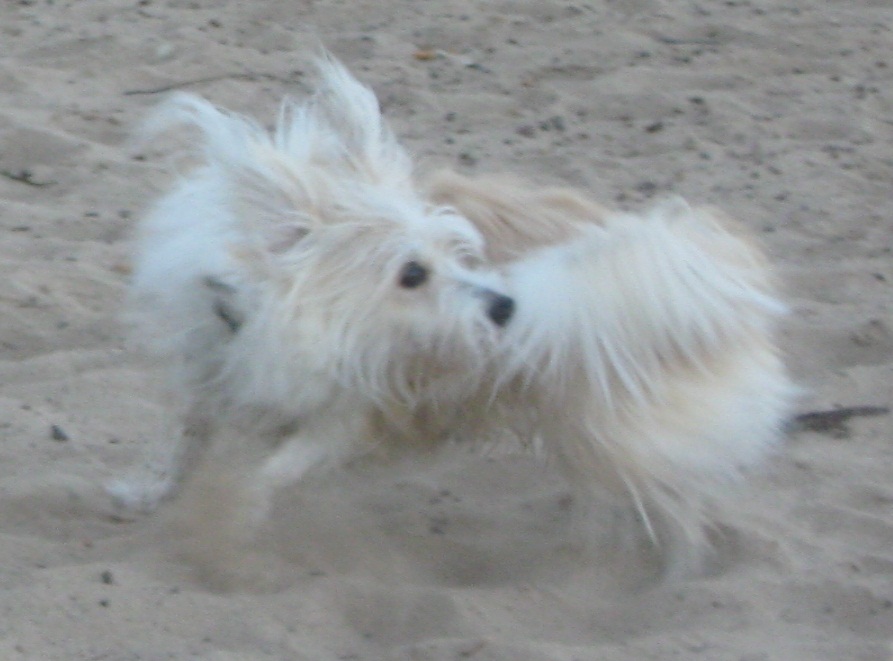
This picture demonstrates Maisy's own take on the check-out: spinning or biting at her tail. I've noticed that she often looks back and/or snaps at her tail when she's over-aroused or stressed. It's similar to the check-out, though not identical, proving that dogs don't read the books on body language!
Pacing or an Inability to Settle
If your dog can't stop moving, he's probably stressed. He may switch positions (sit to down, for example) repeatedly, he may walk back and forth, or he may just seem hyper. No matter how it looks, it's stress.
(Discussion on this video is available here.)

Photo courtesy of Melissa Smith.
This photo of Toby would be funny if it weren't so sad.
Tucked Tail, Weight Shifted Back, Low Body Posture
This is the classic “scared dog” posture.

Photo courtesy of Sara Reusche.
Many dogs will put their tail between their legs and touching their bellies, but interestingly, this is as far as Maisy's tail ever tucks. I think it's because she has such a high tail set to start with, once again demonstrating that each dog is an individual.

Maisy is cautious and low, but interested.

Tucked tail.
Photo courtesy of Sara Reusche.
Muscle Ridges Around Eyes and Mouth
Easy to see on dogs with short hair and expressive faces, but ultimately challenging on a dog like Maisy, muscle ridges are similar to furrowed brows in people, and a great indicator of stress.

Ridges around the eyes, courtesy of 2dogcrazy.

Ridges around the mouth. Photo courtesy of Sara Reusche.
Increased Respiration Rate, or Shallow/Fast Breaking
If a dog is panting more than seems reasonable given the weather or the dog's activity, it's probably stress.

It's hard to tell in this picture, but Maisy is definitely panting in this photo. I don't know if this is true for all dogs, but Maisy's stress pants have her mouth opened only a small amount, as opposed to her tired/happy panting, which is with a wide open mouth.
Trembling
If the dog is shaking, shivering, or trembling, he's probably stressed. This great video example is courtesy of Sara Reusche:
Sweaty Paws
This is a more significant signal- if you can see sweaty paw prints or feel a damp paw, Sarah said you should immediately adjust the dog's environment. Interestingly, the only time I've seen Maisy have sweaty paws is when playing ball- which is a happy thing for her. As a result, I'd classify this as more of an anticipatory behavior, at least for Maisy, and in that one context.

Photo by Aditi Terpstra.
(And his foster mom reports the sweaty paws are disappearing quick!)
Excess SalivationThe more you see, the more stressed the dog likely is. Again, you'll need to take other factors into account, such as tasty food items in the vicinity and breed of dog, but salivation for no reason, or more than seems normal, is probably stress.
Cheek Puffing
When the dog's cheeks puff out, it's a sign of extreme stress. Sarah said it's not very common.
Sunday, May 22, 2011
Sarah Kalnajs Seminar: Body Language Overview
Last month, I attended a seminar presented by Sarah Kalnajs. I was really excited for it because I absolutely love her DVD The Language of Dogs, which is all about body language. Saturday's seminar presentation was basically an expanded version of the DVD (with bonus material on stress), except with lots of new footage. I have to say, Sarah is a genius at getting great video of dogs.
Sarah broke her presentation on body language down into five sections: signs of stress, anticipatory behaviors, cut-off or appeasement signals, distance increasing signals, and distance decreasing signals. Although I'm going to post about each section separately, it's important to keep in mind that body language does not happen this way. You may see body language from multiple categories at the same time, which makes sense since some categories go together neatly- signs of stress quite often accompany distance increasing signals, for example.
Regardless of category, you'll often see several different behaviors instead of just a single one. It's possible that a dog might be subtle with his body language, or that he might show conflicting signals, which is why it's important to take everything in context. Just because something can be a sign of stress (or appeasement, or anticipation, etc.), doesn't mean it is. Further, dogs don't go to seminars, so there will always be the odd dog that uses body language in ways that contradict what Sarah said. This doesn't mean she's wrong, it simply means that every dog is an individual, and as such, it's impossible to make broad generalizations that are correct 100% of the time.
I'm really looking forward to sharing this information with you. I know that the first time I saw Sarah's DVD, a whole new world opened up to me. I had no idea my dog was telling me so much. The more I learn, the more I am amazed by the subtleties to my dog's movements. And I know I'm missing a lot more than I catch. Still, I have been saving up a ton of photos of Maisy exhibiting various body language signals, so this series of posts promises to be awesome, informative, and adorable!
Here's a teaser photo to get you started. I absolutely love this photo in terms of body language. Look how beautifully the barely-eight-weeks-old Via communicates! (Too bad Maisy was kind of being a jerk, though.)

Sarah broke her presentation on body language down into five sections: signs of stress, anticipatory behaviors, cut-off or appeasement signals, distance increasing signals, and distance decreasing signals. Although I'm going to post about each section separately, it's important to keep in mind that body language does not happen this way. You may see body language from multiple categories at the same time, which makes sense since some categories go together neatly- signs of stress quite often accompany distance increasing signals, for example.
Regardless of category, you'll often see several different behaviors instead of just a single one. It's possible that a dog might be subtle with his body language, or that he might show conflicting signals, which is why it's important to take everything in context. Just because something can be a sign of stress (or appeasement, or anticipation, etc.), doesn't mean it is. Further, dogs don't go to seminars, so there will always be the odd dog that uses body language in ways that contradict what Sarah said. This doesn't mean she's wrong, it simply means that every dog is an individual, and as such, it's impossible to make broad generalizations that are correct 100% of the time.
I'm really looking forward to sharing this information with you. I know that the first time I saw Sarah's DVD, a whole new world opened up to me. I had no idea my dog was telling me so much. The more I learn, the more I am amazed by the subtleties to my dog's movements. And I know I'm missing a lot more than I catch. Still, I have been saving up a ton of photos of Maisy exhibiting various body language signals, so this series of posts promises to be awesome, informative, and adorable!
Here's a teaser photo to get you started. I absolutely love this photo in terms of body language. Look how beautifully the barely-eight-weeks-old Via communicates! (Too bad Maisy was kind of being a jerk, though.)

Subscribe to:
Posts (Atom)